Free download
Rent ledger template
A free rent ledger template with a running balance that calculates itself. One ledger per tenancy: rent due, rent paid, late fees, and the balance owed after every entry, plus a lease header so the document stands on its own. No email, no signup.
- Running balance owed, live formula on every row
- Rent due, paid, late fees, payment method, and notes
- Lease header: tenant, unit, term, deposit, late-fee policy
Educational template, not legal advice. Eviction filings have jurisdiction-specific requirements, so confirm the format your local court expects.
What is a rent ledger
A rent ledger is the payment history of one tenancy: every rent charge, every payment, every late fee, and the balance after each line. It is the document a court asks for in an eviction, a lender asks for when you refinance, and a buyer asks for in due diligence. When your word and the tenant's memory disagree, the ledger is what settles it. Its portfolio-level sibling is the rent roll: one row per unit as of a date, where the ledger is one tenancy over time.
What to record on every line
| Column | Why it matters |
|---|---|
| Date and period | Ties each payment to the month it covers, so partial and late payments stay unambiguous |
| Rent due and rent paid | The two sides of the story. A ledger with only payments cannot show what was missed |
| Late fee | Charged per your lease policy, recorded the month it accrues |
| Method | Check number, ACH, cash. The detail courts and auditors ask about first |
| Balance owed | Prior balance plus charges minus payments. The template calculates it for you |
How to use it
Start one ledger per tenancy, fill in the lease header, then add a row per event: a row when rent comes due, a row when a payment lands (same row if they coincide). If the tenancy starts or ends mid-month, that row's rent due is a partial month, and the prorated rent calculator gives the exact figure by actual days or the 30-day method. Enter partial payments as they happen and the balance column carries the shortfall forward. When a tenancy turns over, archive the file with the lease and start a fresh one. Security deposits stay out of the rent rows: the deposit is a liability you hold, not income, which is also why it belongs on your balance sheet instead.
The mistake that ruins ledgers: reconstructing them later
A ledger rebuilt from memory the week before an eviction hearing is worth little, and opposing counsel knows it. The habit that works is recording payments the day they land. If rent arrives by bank transfer, your bank feed already has the dates and amounts; the ledger's job is matching them to the months they cover, which is exactly the kind of reconciliation that goes wrong when it waits until year-end. Come tax time, the income side totals onto Schedule E line 3, and the Schedule E worksheet picks up where the ledger stops.
Frequently asked questions
What is a rent ledger?
The payment history of one tenancy: every rent charge, every payment received, every late fee, and the running balance after each line, with the lease terms up top. It is the document that proves what was paid and what was missed, to a court in an eviction, a lender in a refinance, or a buyer in due diligence.
What should a rent ledger include?
The lease context (tenant, unit, term, monthly rent, deposit, late-fee policy) and then one line per event: date, the period it covers, rent due, amount paid, any late fee, the payment method, and the balance owed after the line. The template has all of these, and the balance column is a live formula.
Why do landlords need a rent ledger?
Because disputes are settled by records, not memory. Eviction courts routinely require a ledger showing charges and payments; lenders ask for one to verify rental income; buyers ask during due diligence. A ledger kept as payments land is strong evidence, one reconstructed the week before a hearing is not.
How do I fill out a rent ledger?
Add a row when rent comes due and a row when a payment arrives (one row if they coincide). Enter partial payments as they happen, and the running balance carries any shortfall forward automatically. One ledger per tenancy: when the tenant changes, archive the file with the lease and start a new one.
Do security deposits go on the rent ledger?
Record the deposit in the header, not the payment rows. A deposit is not rent and not income, it is money you hold and owe back, which makes it a liability on your balance sheet. Mixing it into rent rows distorts the running balance and muddies exactly the record the ledger exists to keep clean.
Does this rent ledger work in Excel and Google Sheets?
Yes. It is a standard XLSX, so it opens in Excel and Numbers directly, and it converts cleanly to a Google Sheet. The running-balance and totals formulas carry over, and you can print it or export a PDF when a court or lender wants a copy.
How I do this in Oberlin24
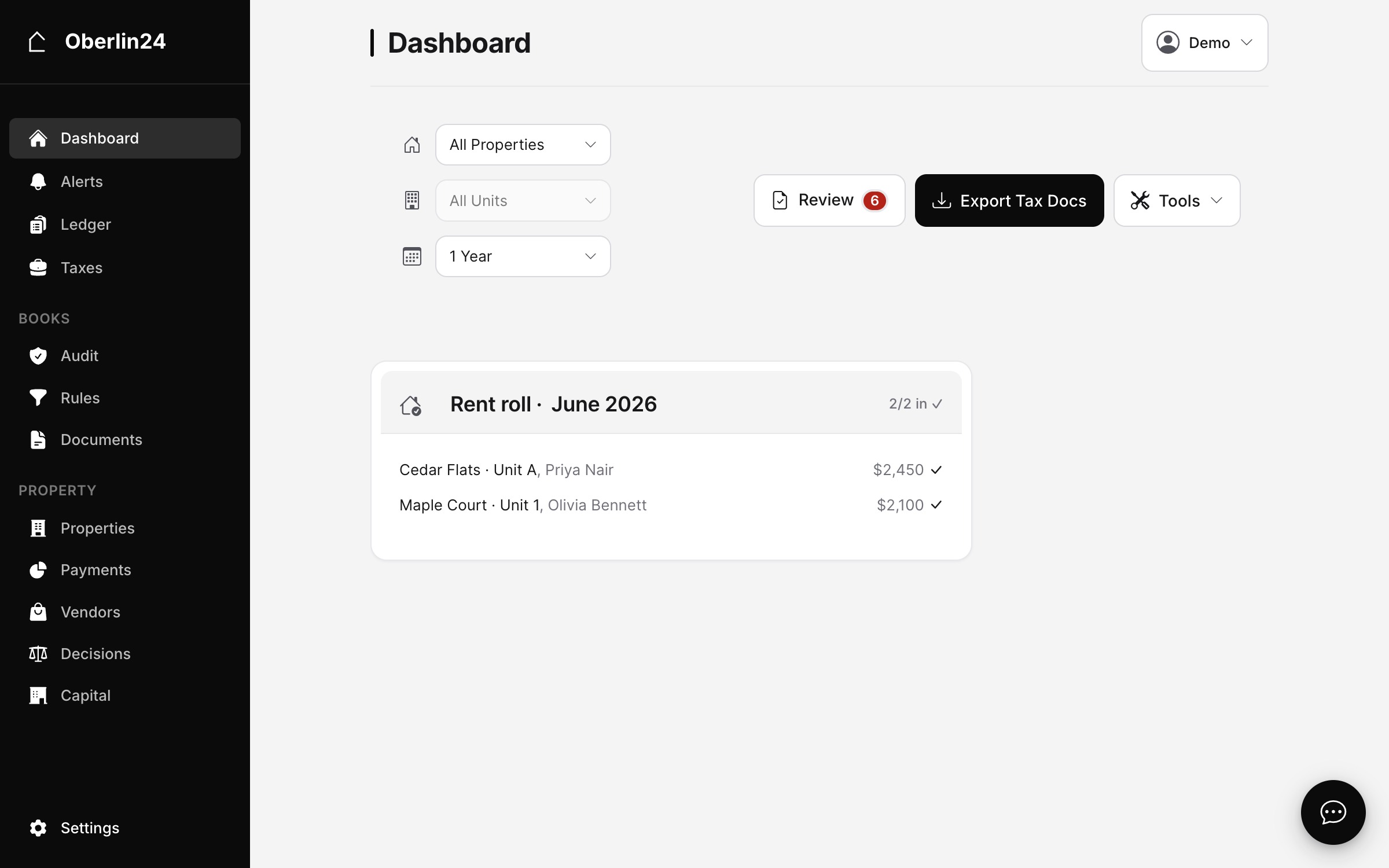
I run two rentals of my own. By hand, that is the ledger above: one file per tenancy that I update the day a payment lands. In Oberlin24 I connect the bank once and it keeps a ledger like this filled for every tenancy. Each deposit is matched to the right tenant and the month it covers, the running balance carries forward on its own, and the month a payment goes missing gets flagged for me. Here it is, kept live from the bank feed:
Prefer to build your own? The shape is not complicated: a bank feed, a rule that matches each deposit to a tenant, and a running-balance column. It is 2026, you can wire that together yourself.
This is one piece of the monthly routine. I wrote up the whole thing, the four monthly moves and the year-end return, in how I do the bookkeeping for both rentals in about a minute a month.