Reconciliation
How to Reconcile Your Rental Property Books (Without a Bookkeeper)
Reconciling proves your rental books are complete and correct. Here is how to do it yourself, the small gaps to expect, and the real culprits behind a balance that won't tie.
Most landlords pour their bookkeeping time into categories. Was that Home Depot run repairs or supplies? Does the water bill go on line 17? Useful questions. But they sit on top of an assumption almost nobody actually checks, which is that the transactions in your books are the same ones that moved through your bank account. Reconciling checks it. It is the step that turns a pile of transactions into books you can actually trust.
It is also the step most people skip, because it sounds like accountant work. It is not. If you can read a bank statement, you can reconcile.
What reconciling actually means
Reconciling an account means proving your books and the bank agree. You take a statement for a period (a month is the natural unit) and confirm two things: every transaction on the statement is in your books, and your books' ending balance for that account matches the statement's, once any pending charges clear.
Tie those out and you have proof. Nothing missing, nothing invented. When they do not tie, the difference between the two balances is the exact size of your problem, and it points straight at what to fix.
That is the whole trick. The bank statement is the record of what actually left and entered the account. Your books are supposed to be a faithful copy. Reconciling is just the comparison that proves they are.
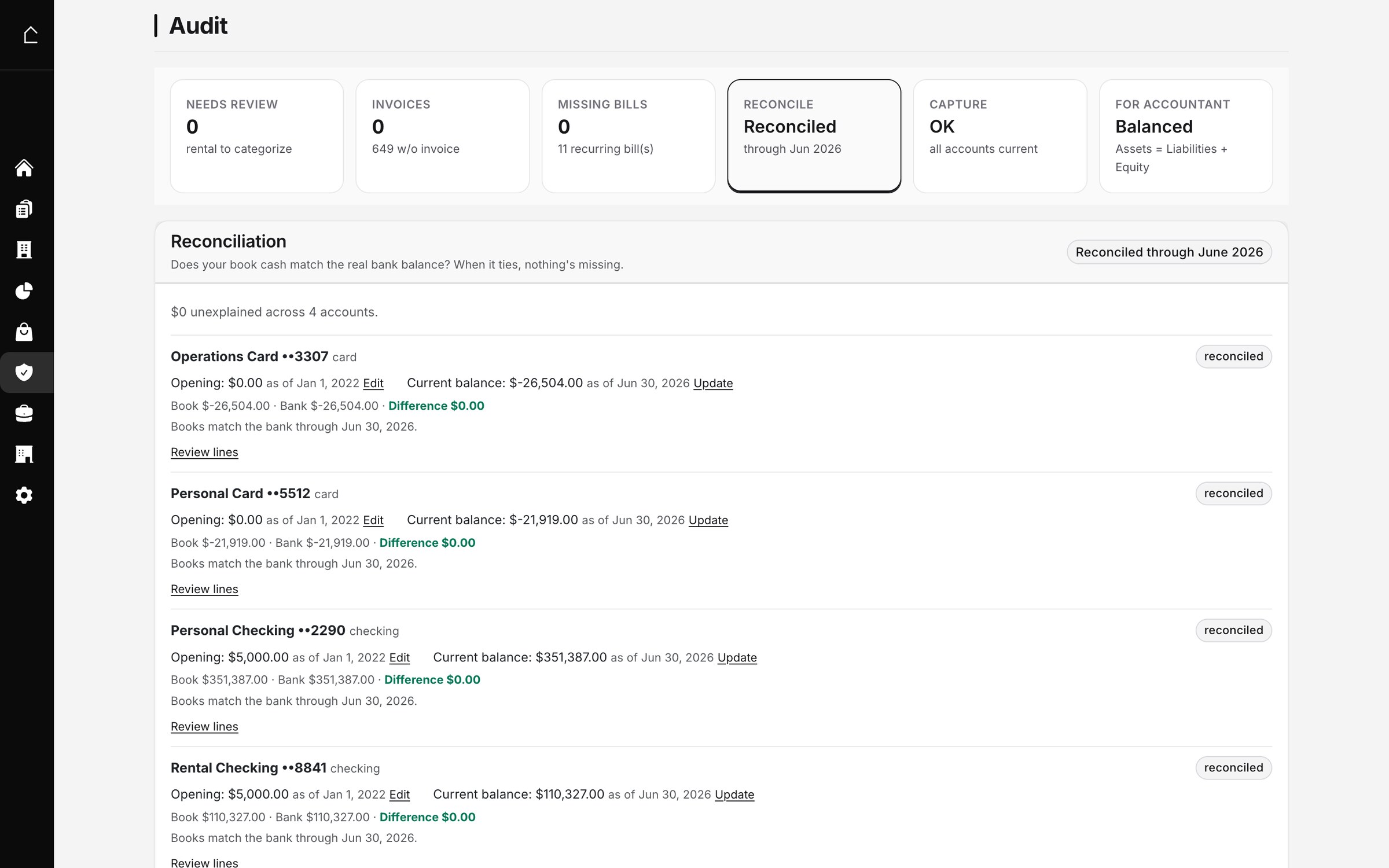
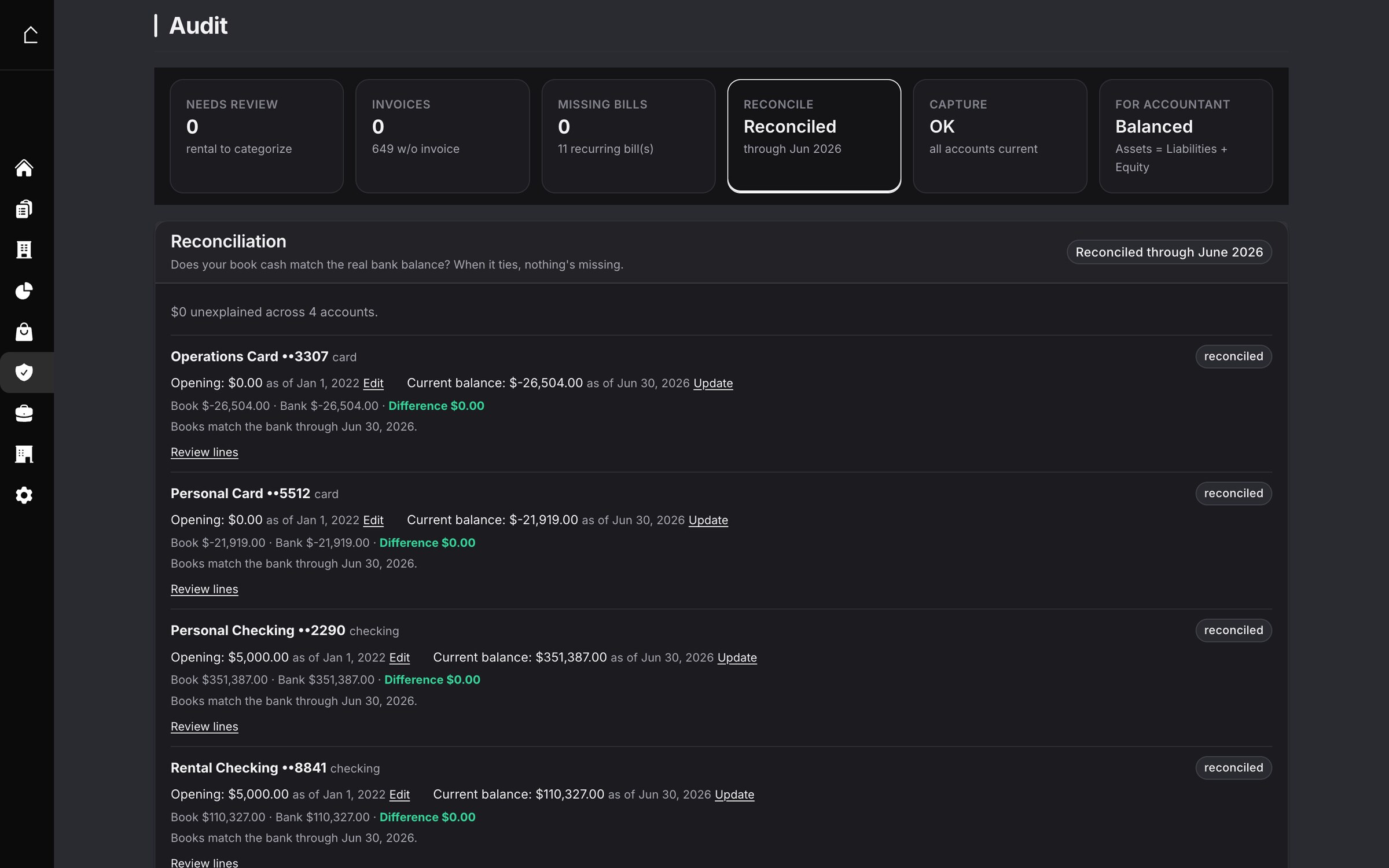
That is a live account in the demo you can open and click through, no signup.
Why it matters more than categorizing
A flawlessly categorized set of books can still be wrong. Categories only describe the transactions you already have, so if a $1,400 insurance payment never made it into your books, no amount of careful tagging puts it there. Your Schedule E just comes up $1,400 short on insurance, and nothing on the page looks the least bit off.
That is why reconciling comes first in any books worth trusting. It settles "is the set complete and correct" before you burn an hour on "what line does each item belong on." Categorize an incomplete set and you have described half the year, neatly. We covered the category side in how to categorize rental expenses for Schedule E; reconciling is what makes those categories worth anything. It is also the kind of supporting record the IRS expects you to keep for rental income and expenses (see Publication 527).
How to reconcile, step by step
The manual process is short.
- Pick one account and one period. A single bank account or card, for one statement month. Do not try to do everything at once.
- Confirm the opening balance. Your books' starting balance should equal the statement's opening balance. If it does not, last month never reconciled. Fix that first.
- Match each transaction. Go down the statement and tick off each line against your books. Most match cleanly. Mark them cleared as you go.
- Find the gap. Compare your ending balance to the statement's. Match? You are done. If not, that difference is your target number.
- Explain the difference. It is always one of a handful of things, covered below. Work them off until the difference is zero.
When the ending balances tie, the account is reconciled. Run the same loop on each account and the whole set is proven. It is the same logic a bank reconciliation follows in any business. Rentals just have fewer accounts to run it on.
The handful of things that cause a gap
Reconcile enough rental accounts and the same culprits keep showing up. If your balance is off, it is almost always one of these four.
A duplicate account from a bank feed. This is the sneaky one. Connect a card through a feed and it can quietly spin up a second copy of an account you already had, so the same charges split across two accounts and neither one reconciles. We hit it on an Amex Platinum. The feed created a duplicate card next to the one already being tracked, and the account sat $49.99 off until we merged the two.
Timing, meaning pending versus posted. A charge can be pending in your books the day you enter it and post to the bank a day or two later, or the other way around. That throws a small difference, and it clears itself once everything settles. On that same Amex, a $40.88 leftover turned out to be a Netflix charge that pended on one date and posted on another. Nothing wrong. The dates just had not caught up to each other.
A sign or direction error. Book a refund as a charge, or a payment as a deposit, and the balance swings the wrong way by twice the amount. Easy to spot, actually: the gap comes out to exactly two times some real transaction.
A genuinely missing transaction. Sometimes a charge just never made it in. A feed hiccup, a receipt you forgot to enter. The statement has it, your books do not, and keying it in closes the gap.
In practice you knock the difference down one cause at a time. Add what is missing. Merge or delete what is duplicated. Flip what has the wrong sign. Leave real timing differences to settle on their own. We have walked an account that was $725 off all the way down to zero doing exactly that, one line at a time, and the same routine keeps nine accounts sitting at a $0 difference today.
Make it a monthly habit
Reconciling feels painful for one reason, almost always: it got left too long. One month is a handful of transactions and a small gap to explain. A year is hundreds of transactions and a gap that might be a dozen separate problems stacked on top of each other.
So do it when each statement closes, ideally the same week. Once you are caught up it is a few minutes per account. If you keep books in spreadsheets, two free templates carry the habit: the rent ledger template keeps the per-tenant payment history your deposits should tie back to, and the balance sheet template is where your reconciled cash balances land at each month-end. And it is the whole difference between books you hope are right and books you have proven are right. The moment your numbers feed a real decision, like the calculators in our free tools or the deduction math behind paying no tax on your rental income, reconciled accounts are what make those numbers mean anything instead of resting on a partial picture.
Keep one bookkeeping habit and make it this one. Categorize when you have the time. But reconcile every single month, because an unreconciled book is a guess, no matter how tidy it looks.
Frequently asked questions
How often should I reconcile my rental accounts?
Once a month, when each bank and card statement closes. Monthly keeps the gaps small and easy to trace. If you have only ever caught up once a year, work through it month by month rather than all at once, because a year of mismatches is far harder to untangle than twelve small ones.
My books are off by a few dollars. Is that a problem?
Usually it is timing, not an error. A charge that posted on a different day than it cleared, or a pending transaction that has not settled, throws a small difference that resolves itself in a day or two. If the gap is a round number or repeats every month, look for a duplicate or a sign flip instead.
Do I still need to reconcile if I use a bank feed?
Yes, and it helps to be clear on what reconciling actually compares: the cash balance in your own books against the balance the bank shows on its statement. You would expect a feed to keep those equal on its own, since the data comes straight from the bank, and often it does. But a feed does not always write your books cleanly. It can create a duplicate account so the same charges split across two, import a transaction twice, or drop one, and it can collide with anything you entered by hand, like a receipt you keyed in that the feed then pulls again. Reconciling each month is the quick check that your books' balance still ties to the bank's, so those slip-ups get caught before they land on your return.
What is the difference between reconciling and categorizing?
Categorizing decides which Schedule E line a transaction belongs on. Reconciling proves the transactions are all there and correct in the first place. You can have perfect categories on an incomplete set of transactions and the books will still be wrong.
Can I reconcile without accounting software?
Yes. All you need is the statement and a way to mark each transaction as matched, even a spreadsheet. Software makes it faster by flagging the gaps for you, but the logic is identical: match what you have, then explain the difference until it is zero.