Free tool
Rental loss deduction calculator
Your rental shows a loss. How much of it actually comes off this year's return depends on your income, not on the loss. Enter the numbers and this runs the passive activity limit the way Form 8582 does: the $25,000 special allowance, the phase-out between $100,000 and $150,000 of modified AGI, and the balance that suspends and carries forward.
Educational estimate, not tax advice. It runs the rental real estate piece of the passive activity rules under Section 469 and ignores credits, at-risk limits under Section 465, the excess business loss limit, and real estate professional status, all of which can change the answer. Nothing you type here is stored.
How the rental loss limit is calculated
Rental income is passive by default, and a passive loss can only offset passive income. That would strand most small landlords, so Section 469(i) carves out a special allowance: up to $25,000 of rental real estate loss deducts against wages, interest, and any other ordinary income, as long as you actively participate.
Three steps, in this order:
- Other passive income absorbs the loss first. If another rental or a passive partnership threw off net income, the loss offsets it dollar for dollar with no limit and no allowance used.
- The allowance covers what is left, up to its ceiling. The ceiling starts at $25,000 and shrinks by 50 cents for every dollar of modified AGI over $100,000, so it is gone at $150,000.
- Everything still unabsorbed suspends. It carries forward on Form 8582, indefinitely, per activity.
The allowance by filing status
Most landlords sit in the first row. The married filing separately rows are the trap, because the penalty for having lived under the same roof at any point in the year is the entire allowance:
| Filing status | Maximum allowance | Phase-out starts | Gone at |
|---|---|---|---|
| Single, head of household, married filing jointly, qualifying surviving spouse | $25,000 | $100,000 | $150,000 |
| Married filing separately, lived apart the whole year | $12,500 | $50,000 | $75,000 |
| Married filing separately, lived together at any point | $0 | Not applicable | Not applicable |
One number worth sitting with: the $25,000 has not moved since the Tax Reform Act of 1986, and neither have the $100,000 and $150,000 edges. They carry no inflation index. A household that was comfortably under the phase-out twenty years ago can be entirely above it now on the same real income, which is why this limit bites far more landlords than it used to.
What modified AGI means here
MAGI for this test is your adjusted gross income computed without the passive loss you are testing, and with a handful of items added back: taxable Social Security, deductible IRA contributions, the student loan interest deduction, and foreign earned income exclusions. Rental losses you are allowed do not reduce it, so you cannot use the allowance to qualify for more of the allowance.
What does move it is anything that lowers AGI before this test: a 401(k) deferral, an HSA contribution, a health insurance deduction if you are self employed. In the $100,000 to $150,000 band each dollar of AGI you defer buys back 50 cents of allowance, so a $10,000 deferral is worth $5,000 of extra deductible loss. That is the one lever available after the year is already underway.
What happens to the loss you cannot deduct
It is banked, not burned. A disallowed loss becomes a suspended passive loss, tracked per activity on Form 8582, and it carries forward with no expiry. It has three exits:
- Passive income in a later year. A rental that turns profitable eats its own carryforward first.
- A lower MAGI year. Drop back under $150,000 and the allowance reopens for the carryforward, not just the current year's loss.
- A fully taxable sale. Sell the property to an unrelated buyer and every suspended loss from that activity releases at once, against any kind of income, including the gain on the sale itself.
That last exit is why the balance matters at decision time and not only at filing time. A 1031 exchange is not a taxable disposition, so it keeps the losses suspended, and on a portfolio carrying a large enough balance the released deduction can make an outright sale beat the exchange. The sell vs hold vs 1031 calculator takes the suspended figure as an input for exactly that reason. The full mechanics are in the write-up on the $25,000 rental loss rule and in how the passive activity loss rules work.
Active participation is not material participation
Two different bars, and mixing them up is the most common error on this calculation. Active participation is what the $25,000 allowance asks for: own at least 10% of the property and make real management decisions. Approving a tenant, setting the rent, and authorizing a repair clear it, and hiring a property manager does not break it as long as the calls are yours.
Material participation is a much higher bar, and clearing it through real estate professional status takes the rental out of the passive category entirely, which removes the limit rather than raising it. That path needs more than half your working time and at least 750 hours in real property trades, with contemporaneous records. Most self managing landlords with a day job clear the first bar and not the second.
Getting the loss figure right first
The limit runs on the number at the bottom of Schedule E, so the answer is only as good as the return line above it. Two things move it more than anything else. Depreciation is usually the reason a cash flow positive rental shows a tax loss at all, so a missing or understated depreciation schedule often means the loss you are testing is too small. And a capital improvement miscoded as a repair inflates this year's loss into a suspended balance while stripping the deduction from the 27.5 years it belonged to, which the repair vs improvement tool settles line by line. If you are assembling the return by hand, the Schedule E worksheet keeps the income and expense lines in one place.
Frequently asked questions
How much of a rental loss can I deduct in one year?
Up to $25,000, if you actively participate and your modified AGI is $100,000 or less. Above that the allowance shrinks by 50 cents per dollar of MAGI and reaches zero at $150,000. Before the allowance is touched, net income from your other passive activities absorbs the loss dollar for dollar with no cap. Anything left over is not deductible this year; it suspends and carries forward.
What is the $25,000 special allowance for rental losses?
A carve-out in the passive activity rules, Section 469(i), for hands-on small landlords. Passive losses normally offset only passive income, which would strand most landlords who have a day job. The allowance lets up to $25,000 of rental real estate loss come off wages and other ordinary income instead. It requires at least 10% ownership and active participation, and it phases out on income. Note that neither the $25,000 nor the $100,000 phase-out floor has been indexed for inflation since 1986.
What counts as modified AGI for the rental loss allowance?
Adjusted gross income figured without the passive loss you are testing, and with certain items added back: taxable Social Security, deductible IRA contributions, the student loan interest deduction, and the foreign earned income and housing exclusions. Allowed rental losses do not reduce it, so the allowance cannot be used to qualify for more of itself. Deferrals that reduce AGI, such as a 401(k) or an HSA contribution, do move it, and inside the phase-out band each dollar deferred buys back 50 cents of allowance.
What happens to the rental loss I cannot deduct?
It becomes a suspended passive loss, tracked per activity on Form 8582, and carries forward indefinitely. It releases in three ways: against passive income in a later year, against the allowance in a year your MAGI drops back under the phase-out, or in full when you sell that property in a fully taxable sale, where it offsets any kind of income including the gain itself. A 1031 exchange is not a taxable disposition, so it leaves the losses suspended.
Can married filing separately claim the rental loss allowance?
Only if you lived apart from your spouse for the entire year, and then the allowance is halved to $12,500 with the phase-out running from $50,000 to $75,000. If you lived together at any point during the year, the allowance is zero and the whole loss suspends. This is one of the sharpest penalties in the filing-status comparison, and it is worth pricing before choosing to file separately in a loss year.
Do I have to file Form 8582?
You file it when you have passive activity losses that are limited, which includes the year you first suspend a loss and every year you carry a balance. If your rental loss is fully allowed, and the only passive activity is rental real estate covered by the allowance, many filers can skip the form. Keep the worksheets either way: the per-activity suspended balance is a stored deduction, and reconstructing it years later from old returns is the miserable part of selling a rental.
How I do this in Oberlin24
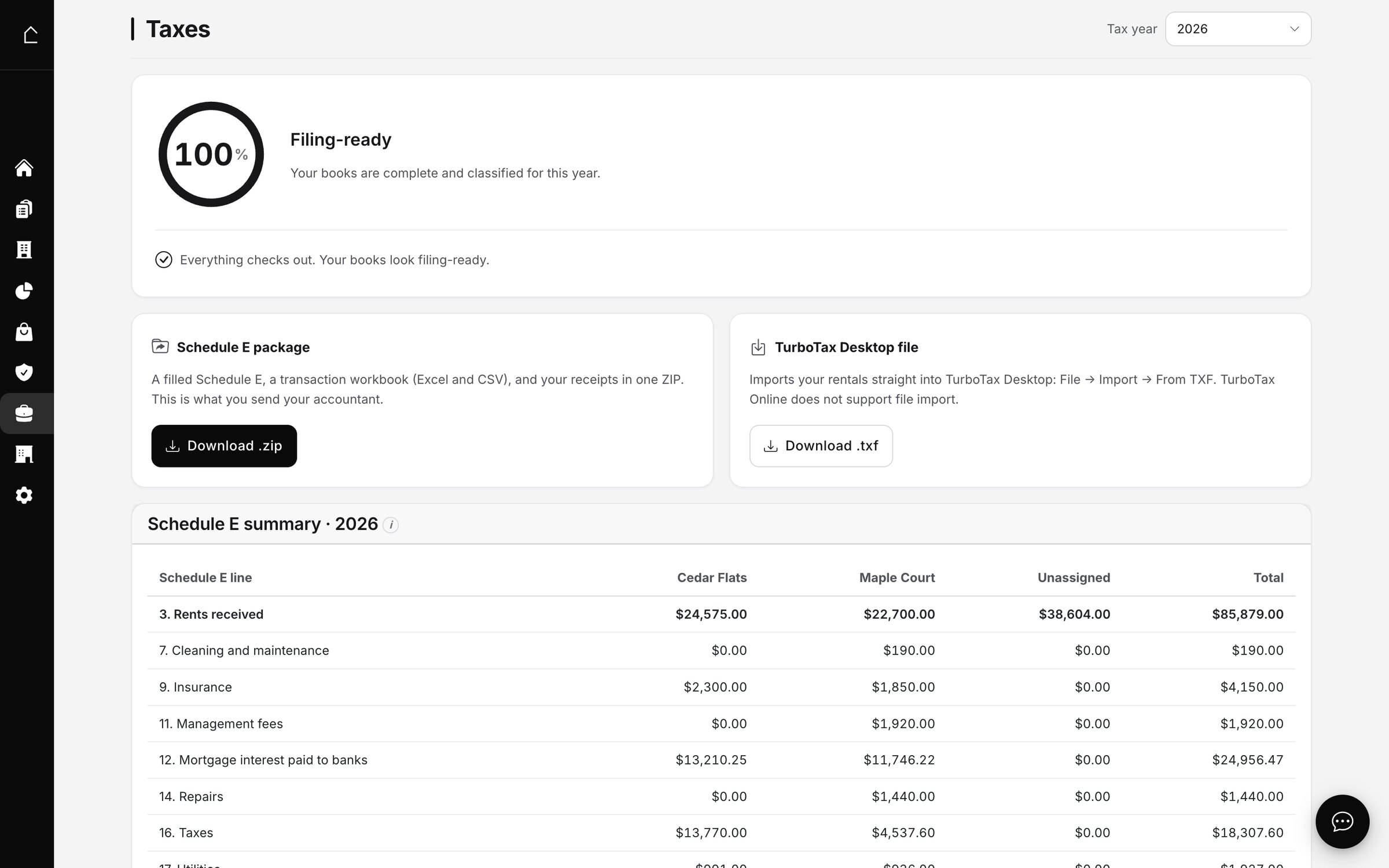
I run two rentals of my own, and this calculation has two inputs I used to chase every spring: this year's Schedule E net, and the suspended balance already carried forward. Oberlin24 builds the first one from the bank feed, per property, so I can see in September whether the year is heading for a loss instead of finding out in April. The second one it reads off the Form 8582 in my filed return, per activity, so the carryforward is a number the app carries rather than something I reconstruct from old PDFs the year I sell. On my own books that balance is what made an outright sale beat a 1031, and I would not have known without it.
Prefer to keep it in a spreadsheet? That works too. You need three columns per property: the year, the loss allowed, and the loss suspended, updated the day you file. The hard part is not the arithmetic, it is still having the file eight years later.
This is one piece of the monthly routine. I wrote up the whole thing, the four monthly moves and the year-end return, in how I do the bookkeeping for both rentals in about a minute a month.