Schedule E
How to Categorize Rental Property Expenses for Schedule E (2026)
A practitioner's guide to sorting rental expenses onto the right Schedule E line, including the repair-vs-improvement safe harbors and the QuickBooks subtype trap that quietly understates your repairs.
Most of your April tax pain gets decided months earlier. Not in April, but in how each expense got categorized the day it cleared. Tag things as the money moves and your Schedule E is basically a sum at year end. Leave it for March, and you are rebuilding a year of bank activity from memory, which is exactly where real deductions slip through.
A few of these calls are worth real money. So here is how the categories work, plus the one QuickBooks habit I keep watching misfile actual repairs even when the books look finished.
Schedule E has 15 expense lines
Schedule E (Form 1040) reports rental income and expenses. Income sits up top (line 3 is your rents received, which is why a clean rent ledger per tenancy pays off at filing). Everything you spend rolls into one of fifteen expense lines, 5 through 19:
| Line | Category | Typical examples |
|---|---|---|
| 5 | Advertising | Listing fees, signs, screening ads |
| 6 | Auto and travel | Mileage to the property, out-of-town trips |
| 7 | Cleaning and maintenance | Turnover cleaning, lawn, snow, pest control |
| 8 | Commissions | Leasing commissions |
| 9 | Insurance | Landlord, hazard, and liability policies |
| 10 | Legal and professional | Attorney, CPA, bookkeeping |
| 11 | Management fees | The property manager's cut |
| 12 | Mortgage interest paid to banks | The interest portion of your payment |
| 13 | Other interest | Interest not on line 12 |
| 14 | Repairs | Fixing what is broken, not improving it |
| 15 | Supplies | Filters, light bulbs, small hardware |
| 16 | Taxes | Property tax and some local taxes |
| 17 | Utilities | Water, sewer, electric, gas, trash, internet |
| 18 | Depreciation | The annual write-down of the building and improvements |
| 19 | Other | Legitimate items that fit nowhere above, like HOA dues or bank fees |
Tag every transaction to one of these as it lands and the year-end form mostly fills itself. That part is mechanical. The money gets lost in the two lines that are judgment calls, so those are the ones to slow down on.
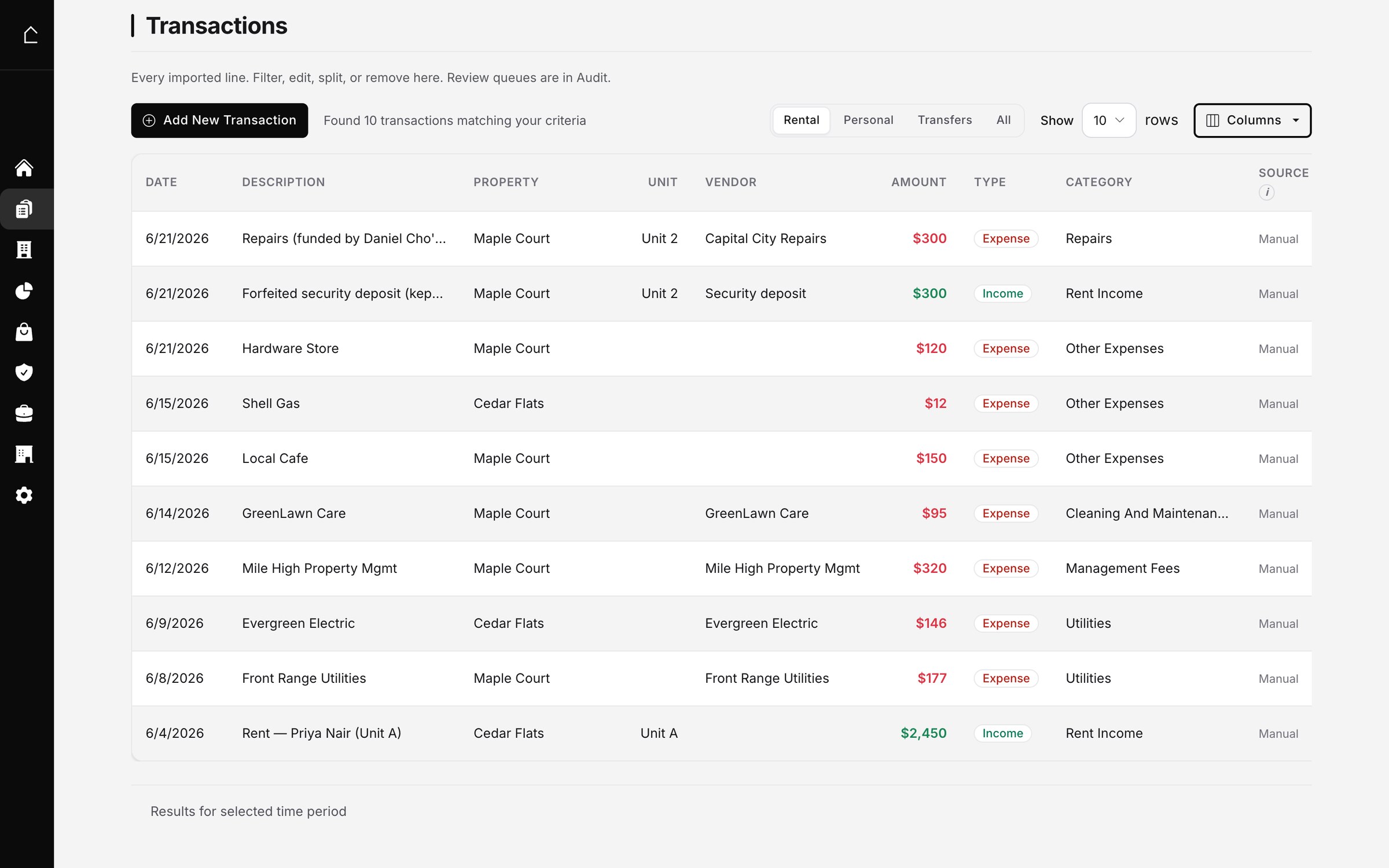
You can click through this exact view on a real set of books in the live demo, no signup and nothing to install.
Repairs vs. improvements: the line that actually costs you (line 14 vs. line 18)
A repair just keeps the property working. You patch a roof leak, swap a dead water heater for a comparable one, repaint after a tenant moves out. That comes off this year, on line 14.
An improvement is a different animal. A new roof. A gut kitchen remodel. An addition that turns a duplex into a triplex. The tax word for it is "capitalize," and it means you spread the cost over 27.5 years on line 18 instead of taking it now. That line-18 depreciation is also the deduction that most often turns a cash-positive rental into a zero on the tax return, which is the whole mechanism behind paying little or no tax on rental income.
The urge to call everything a repair is completely understandable. A write-off this year beats one dribbled out over 27.5 years, and the cash difference is real. But the line is not yours to draw by preference. The IRS tests an improvement with what gets shorthanded as BAR: betterment, adaptation, restoration. A roof replacement restores. Finishing a basement into a rentable unit adapts. Call either one a line-14 repair and you are not reading the test the way it actually reads, which is the kind of thing an examiner checks first.
Three safe harbors pull specific costs back into "deduct now." For most small landlords they come up more often than the BAR test does:
- De minimis safe harbor. Make the annual election and you can expense items costing up to $2,500 each instead of capitalizing them (per invoice or item, for a landlord without an applicable financial statement). That $400 replacement garbage disposal? Usually qualifies.
- Small-taxpayer safe harbor. If a building's unadjusted basis is $1,000,000 or less, you can expense the year's total repairs, maintenance, and improvements on it, as long as the total stays under the lesser of $10,000 or 2% of that basis.
- Routine maintenance safe harbor. Work you reasonably expect to do more than once over ten years, to keep the building running, stays deductible.
Those are the current-law figures, and the numbers and elections behind them do shift. Confirm them for your tax year with your CPA before you lean on any of them. The takeaway is simpler than the rules: repair-vs-improvement is not a coin flip. There are bright lines, and the harbors are usually more generous than landlords assume.
We spent more time getting this one rule right than almost anything else when we built the depreciation engine behind Oberlin24. The reason is a single misfiled $9,000 "repair" that is really a roof, which is exactly what turns a clean return into an audit conversation. Want the year-one and lifetime numbers on a specific improvement? The rental depreciation calculator runs the 27.5-year math.
The trap that survives careful categorizing: the account name lies
This is the one that cost us the most time. And it is invisible if you only read account names.
In QuickBooks, the Schedule E line an account maps to is set by its underlying AccountSubType. Not by whatever you named it. So two accounts can read almost identically to a human and still land on completely different tax lines.
Here is a real one, from a set of books we cleaned up. An account named "Maintenance and Repairs" carried the subtype OtherMiscellaneousServiceCost, which rolls up to Schedule E Other. Not Repairs. A $450 plumbing fix sat in it and never reached line 14. Nothing looked wrong, either. The charge was categorized, the account name made sense, the totals balanced, nothing flagged. The repairs line was just quietly short $450, and a name-only review sails right past it, because the name literally says "Repairs." Meanwhile a second account, "Building Repairs," carried the subtype RepairMaintenance and mapped to line 14 correctly. Same words to a person. Two different outcomes on the return.
That is why our diagnostic reads the subtype, not the label. On that two-property book, clearing this one class of mismap, a handful of repair-type charges stranded in Other and Misc accounts, was part of what moved its Schedule E readiness from 71% to 92%. The money was never missing from the bank. It just sat on the wrong line, and a real $450 deduction never made it onto the return.
The rule holds whether you do this by hand or with software. Categorize by what the expense actually is. Then check that the account it lands in maps to the right line by subtype, the way the form reads, instead of trusting the name on the account.
A routine that holds up
- Categorize as the money moves, not in March. A charge you tag the day it clears is one you still remember.
- Split the payments that are really two things. A mortgage payment is interest (line 12) plus non-deductible principal. An escrow disbursement turns into property tax (line 16) and insurance (line 9) when the servicer actually pays it.
- Make the repair-vs-improvement call before you file, using the safe harbors above. When a specific cost is a close call, the repair or improvement decision tool runs it through the BAR test and the three harbors to a repair-or-capitalize verdict, so you can see which line it lands on. Anything over a few thousand dollars, write yourself one line on why you treated it the way you did. Future-you will want it.
- Tag every transaction to its property, so a per-property Schedule E is one filter click, not a reconstruction. If you are tallying by hand, the free Schedule E worksheet keeps each property in its own column and totals the lines for you.
- Reconcile to the bank so you know the set is even complete. Clean categories on half your transactions is not clean books. Here is how to reconcile rental books without a bookkeeper.
- Keep security deposits out of income while you hold them. A refundable deposit is a liability you owe back, not rent, and it only becomes income in the year you keep part of it. Categorize it to a deposits-held account, not to line 3. The full lifecycle, both journal entries included, is in rental property security deposit accounting.
- On a condo, read the assessment letters. Monthly HOA dues are a plain line 19 expense, but a special assessment forks the same way a repair does. One covering storm damage or a budget shortfall deducts in the year you pay it. One funding a new roof is a capital improvement you depreciate over 27.5 years, even though the association hired the contractor, not you. The letter says which, so file it the day it arrives. The full line-19 treatment, part-year proration included, is in can you deduct HOA fees on taxes.
None of these takes more than a minute when the charge is sitting in front of you. The expensive version is the one where you do none of it until March, then rebuild a year from memory and go hunting for the lines you missed.
Change one habit this year and make it this: categorize as the money moves, and glance at the subtype while you are there. Do that, and March stops being a reconstruction project. And if your books already look finished but the repairs total looks light for the year, the subtype mapping is the first place we look.
Frequently asked questions
Do I have to use the exact Schedule E categories?
You report totals on the 15 expense lines of Schedule E (lines 5 through 19). You can keep finer categories in your own books, but every expense has to roll up to one of those lines at tax time, so it is easier to categorize that way as you go.
Is a new appliance a repair or an improvement?
Replacing an appliance is usually a capital improvement you depreciate, not a line-14 repair, unless it qualifies for the de minimis safe harbor. For a landlord without an applicable financial statement, that harbor currently covers items up to $2,500 each, claimed with an annual election on your return. Fixing the existing appliance is a repair. Thresholds change, so confirm the current figure with your CPA.
Where does my mortgage payment go?
Split it. The interest portion goes on line 12. The principal portion is not deductible and does not belong on Schedule E at all; it reduces your loan balance. Escrow amounts get reclassified to taxes (line 16) and insurance (line 9) when the servicer actually pays them out.
What about money I spent before the property was rented?
Costs to get a property ready to rent for the first time are generally added to your basis and depreciated, not deducted as current expenses. Once the unit is available to rent, ordinary operating costs become deductible. The line between getting-ready and operating is worth confirming with your CPA on a specific spend.