Free tool and download
Estimated tax on rental income: a quarterly worksheet
A free estimated tax worksheet for landlords. Start from the Schedule E net after depreciation, see what the rental adds to your federal tax each quarter, and check the safe harbor that keeps you clear of an underpayment penalty. Rental income has no withholding, so this is the part nobody does for you. No email, no signup.
The rental for the year
The safe harbor
Educational estimate, federal only, not tax advice. It uses the bracket you pick rather than a full return, so check the figure with your tax preparer. Nothing you type here is stored.
- A set-aside sheet from rents, expenses and depreciation to the federal, NIIT and state tax the rental adds
- A safe harbor sheet with the 90%, 100% and 110% tests, withholding and the under-1,000 rule
- A payment log with the four due dates for the year, and a sheet of common landlord traps
Do landlords have to pay estimated taxes?
Often, yes. Rent arrives with nothing withheld, so if your rentals show a profit after depreciation, the tax on that profit is due during the year, not in April. The IRS expects it in four payments with Form 1040-ES. The test is simple: if you expect to owe 1,000 or more when you file, after withholding and credits, you need to pay during the year, either with estimates or with more withholding from a job.
Many landlords owe nothing extra. Depreciation often pulls the Schedule E net close to zero, and a rental in a loss year adds no tax at all. The worksheet tells you which case you are in before the first due date, not after.
A worked year
A landlord with one rental and a W-2 job, married filing jointly. The house rents for 3,000 a month. The job withholds 14,000 for the year. Last year's total tax was 15,200, and AGI was under 150,000.
| The rental for the year | Amount |
|---|---|
| Rents received (line 3) | 36,000.00 |
| Mortgage interest, taxes, insurance, repairs, management | (14,400.00) |
| Depreciation (line 18) | (9,800.00) |
| Net rental income | 11,800.00 |
| Federal tax the rental adds, at the 22% bracket | 2,596.00 |
| Rental set-aside per quarter | 649.00 |
The cash flow is 21,600 before the mortgage principal. Setting aside 22% of that would park 4,752 for a tax of 2,596. Depreciation is the difference: a deduction with no cash going out.
The safe harbor: the least you can pay
There is no underpayment penalty if withholding plus estimates, paid on time, reach the smaller of two figures:
- 90% of this year's tax, or
- 100% of last year's tax, or 110% if last year's AGI was over 150,000 (75,000 married filing separately).
| The worked year | Amount |
|---|---|
| Projected total tax this year, rental included | 18,400.00 |
| 90% of this year's tax | 16,560.00 |
| 100% of last year's tax | 15,200.00 |
| Required for the year (the smaller) | 15,200.00 |
| Expected withholding from the job | (14,000.00) |
| Minimum estimated payments for the year | 1,200.00 |
| Minimum per quarter | 300.00 |
Two answers, and they are to different questions. 300 a quarter avoids the penalty, but it leaves 3,200 due in April. 649 a quarter pays the rental's own tax as it is earned and leaves 1,804, the part that comes from the job's withholding running short. The worksheet pays the larger of the two, so there is no penalty and the rental pays its own way.
When the four payments are due
| Payment | Covers income from | Due for the 2026 tax year |
|---|---|---|
| Q1 | January 1 to March 31 | April 15, 2026 |
| Q2 | April 1 to May 31 | June 15, 2026 |
| Q3 | June 1 to August 31 | September 15, 2026 |
| Q4 | September 1 to December 31 | January 15, 2027 |
A date that falls on a weekend or holiday moves to the next business day. You can skip the January payment if you file the return and pay the whole balance by the end of January. Pay at IRS Direct Pay or through EFTPS, and keep the confirmation number on the payment log.
What is different about rental income
- No self-employment tax on a long-term rental. The estimate is income tax only, unlike a freelancer's. A short-term rental where you provide hotel-like services goes on Schedule C and can owe it.
- Depreciation counts. Figure the set-aside on the Schedule E net, never on the rent or the cash flow.
- A loss may not help. A rental loss is passive. The 25,000 allowance shrinks between 100,000 and 150,000 of modified AGI, so a loss on Schedule E does not always lower the tax on your wages. Set aside nothing for the rental, but do not cut your withholding on the strength of the loss.
- The 3.8% net investment income tax applies to rental income once modified AGI is over 200,000 single or 250,000 joint, on the smaller of the rental net and the excess.
- Uneven rent, such as a property bought mid-year or a big December payment, can use the annualized method on Form 2210 so the early quarters are smaller.
- Withholding counts as paid evenly through the year. Raising your W-2 withholding in the fall can cover a quarter you missed in the spring.
Where the numbers come from
The rents and expenses are your Schedule E for the year so far, projected to December. The Schedule E worksheet builds that net property by property. Depreciation for the year is on the depreciation schedule template, or run the depreciation calculator for a new property. If the net is a loss, the rental loss deduction calculator shows how much of it the passive loss rules let through this year.
Frequently asked questions
Do I have to pay estimated taxes on rental income?
If you expect to owe 1,000 or more when you file, after withholding and credits, yes. Rent comes with nothing withheld, so a profitable rental usually means quarterly payments with Form 1040-ES, or more withholding from a job to cover it. Many landlords owe nothing extra, because depreciation pulls the Schedule E net close to zero or into a loss.
How much should I set aside for taxes on rental income?
Figure it on the Schedule E net after depreciation, not on the rent or the cash flow. Multiply that net by the federal bracket it lands in, add the 3.8% net investment income tax if your modified AGI is over the threshold, and add your state rate. A long-term rental owes no self-employment tax, so that is the whole federal figure.
What is the safe harbor for estimated taxes?
There is no underpayment penalty if withholding plus estimated payments, made on time, reach the smaller of 90% of this year's tax or 100% of last year's tax. If last year's AGI was over 150,000 (75,000 married filing separately), the prior year figure is 110%. Meeting it avoids the penalty, but it does not mean nothing is due in April.
When are estimated tax payments due?
April 15, June 15 and September 15 of the tax year, and January 15 of the next year. A date on a weekend or holiday moves to the next business day. You can skip the January payment if you file the return and pay the whole balance by the end of January.
Is rental income subject to self-employment tax?
Not for an ordinary long-term rental reported on Schedule E. Rent is passive income, so the estimate is income tax only. A rental where you provide substantial services, like a hotel or a bed and breakfast, goes on Schedule C and can owe self-employment tax.
What if my rental shows a loss?
Then the rental adds no tax and needs no set-aside. But a rental loss is passive, and the 25,000 special allowance phases out between 100,000 and 150,000 of modified AGI, so the loss may not lower the tax on your wages. Do not cut your withholding on the strength of a Schedule E loss until you know how much of it you can deduct this year.
How I do this in Oberlin24
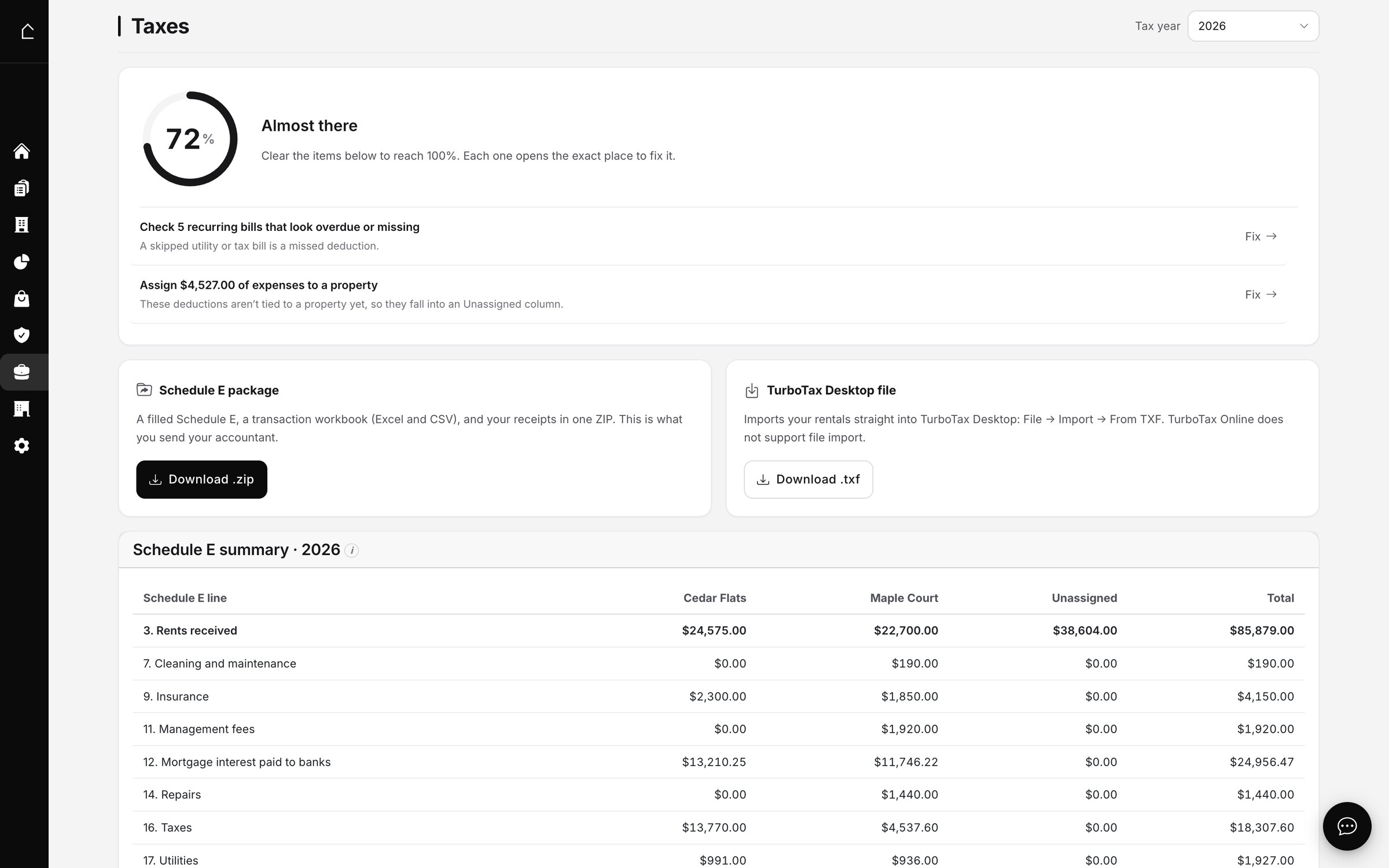
By hand, it is this worksheet once a quarter, rebuilt from wherever my books stand. In Oberlin24 the Taxes page does it from the year's Schedule E as it is booked: I tell it my filing status, my other income, last year's tax and my withholding once, and it shows the federal tax the rental adds, the four Form 1040-ES amounts, and whether my withholding plus those payments clears the safe harbor. In a loss year it says why it set aside nothing. About three weeks before each due date it reminds me with the amount.
Prefer to keep your own? The workbook above is the whole method: one set-aside sheet, one safe harbor check, one log.
This is one piece of the monthly routine. I wrote up the whole thing, the four monthly moves and the year-end return, in how I do the bookkeeping for both rentals in about a minute a month.