Free download
Rental property mortgage payment worksheet
One debit leaves your bank every month and four different things are inside it. Only some of them are deductible, and the deductible part is not the part that left the account. This worksheet splits the year into principal, interest and escrow, reconciles the escrow account to what the servicer actually paid out, and hands you Schedule E lines 12, 9 and 16. No email, no signup.
- Payment log: what left the bank, split into principal, interest, escrow and lender charges, with a per-row check that the parts tie
- Escrow sheet: deposits in, what the servicer actually paid out, and whether your December 31 balance agrees with the lender's
- Schedule E sheet: lines 12, 9 and 16 computed, plus the part that is not a deduction at all, and a proof that every dollar is accounted for
Educational template, not tax advice. It prepares the numbers; filing is yours or your CPA's. Confirm your own facts with your CPA.
One payment, four different answers
A rental mortgage payment is not an expense. Parts of it are, parts of it are not, and the split changes every month as the loan amortizes. Take the seeded year in the worksheet: a $320,000 loan at 6.5%, opened in 2024, with $520 a month going into escrow. Over twelve payments $30,511.41 left the bank. Of that, $26,288.32 is deductible this year and $4,223.09 is not, and there is nothing unusual about those numbers.
| Inside the payment | The seeded year | Where it goes |
|---|---|---|
| Interest | $20,243.32 | Schedule E line 12, mortgage interest paid to banks |
| Escrow, the part the servicer paid to the county | $4,560.00 | Schedule E line 16, taxes |
| Escrow, the part the servicer paid the insurer | $1,485.00 | Schedule E line 9, insurance |
| Principal | $4,028.09 | Nowhere on Schedule E. It repays the loan |
| Escrow you funded that has not been spent yet | $195.00 | Nowhere yet. It is a balance you own |
Deduct the whole payment and you overstate the year by $4,223.09. Deduct only the interest and you leave $6,045 of real property tax and insurance on the table. Both mistakes are common, and they run in opposite directions, which is why the worksheet's last sheet proves the split rather than just listing it: what left the bank, minus what is deductible, has to equal the principal plus the escrow still sitting there. If it does not tie, something is in the wrong column.
Escrow deposits are not deductions
This is the rule that catches careful people. You pay $520 a month into escrow, so $6,240 went in over the year, and $6,240 feels like the deduction. It is not. Publication 527 allows only the amount actually paid out of the escrow account during the year. In the seeded year the servicer paid two tax installments of $2,280 and one insurance premium of $1,485, which is $6,045, and the other $195 is still in the account on December 31. It is your money, it is an asset, and it becomes a deduction in whatever year it is finally spent.
The error is small in one year and it never stops. An escrow balance that grows $195 a year is $195 of overstated deduction every year, forever, on a number nobody re-examines. And it runs the other way too, which is the version people miss: in a shortage year the servicer pays out more than you put in, the balance falls, and your deduction is larger than your deposits. Reading deposits instead of disbursements costs you money that year.
The figures come off the annual escrow analysis statement the servicer is required to send you, which lists every disbursement with its date. The worksheet's Escrow sheet asks for the lender's December 31 balance and tells you whether your entries reproduce it. When they do not, the usual cause is a disbursement you never entered, which is a deduction you were about to lose.
Principal is not an expense
The principal portion repays the loan. It reduces what you owe, so it lands on the balance sheet as equity, not on Schedule E as a cost. That is the single most common rental bookkeeping error, and it is a big one: in the seeded year it is $4,028, and on a newer or larger loan it is larger still. Software that imports the bank feed and categorizes the whole $2,542 debit as "Mortgage" gets this wrong by default, which is why the split has to happen somewhere.
Keeping principal visible is worth doing for its own sake. It is the part of the payment that is buying you something, and a year where $4,028 of the cash flow went into equity reads very differently from a year where it went out the door. The balance sheet template is where it belongs.
Points, PMI, and the two that get reversed
Points are amortized, not deducted. A homeowner can deduct points on a loan to buy a principal residence in the year paid, under the section 461(g)(2) exception. A rental does not get that exception. Points on a loan to acquire or improve a rental are deducted ratably over the life of the loan, so $4,500 of points on a 30-year loan is $150 a year, and that slice belongs on line 12 alongside the interest. If you refinance and pay the old loan off, the unamortized remainder of the old loan's points generally deducts in that year, which is a real deduction sitting in a lot of refinance paperwork.
PMI on a rental is an ordinary expense. Mortgage insurance on a personal residence is a Schedule A question with its own rules and income limits. On a rental it is not: it is an ordinary and necessary cost of carrying the property, and it goes on line 9 with the rest of the insurance. The worksheet has a column for it in the payment split for exactly that reason. One caveat, for the FHA-style case where a large premium is paid up front rather than monthly: a prepaid premium covering future years is spread across the period it covers rather than deducted all at once.
One more that is worth a note in your file the year it happens. Mortgage interest follows what the borrowed money was used for, not which property secured the loan and not which account the payment left. Interest on a cash-out refinance is deductible on this property only to the extent the cash went into this property; the rest has to be traced to wherever it actually went. And if you pay the mortgage from a personal checking account, the interest is still fully deductible, because the account is not the test. Nobody reconstructs either of these three years later.
Where each number comes from
| You need | Read it off |
|---|---|
| Interest for the year | Form 1098, box 1. Check it against the Interest column; if they disagree, one of them is counting a January payment differently |
| The month-by-month principal and interest split | The lender's amortization schedule, or the year-end statement's transaction history |
| What the servicer paid out of escrow | The annual escrow analysis statement, which lists each disbursement and its date |
| Escrow balance on January 1 and December 31 | The same escrow analysis statement. Form 1098 box 10 sometimes carries the property tax figure, and it is often blank |
| Points still being amortized | The closing disclosure from the year you bought or refinanced |
Where this sits in the rest of the books
The mortgage is one line of a Schedule E that has eighteen of them. The Schedule E worksheet lays out the whole form, the rental property spreadsheet is the income and expense ledger this worksheet feeds, and the chart of accounts gives the split real account names if you are keeping the books in QuickBooks. For the reasoning behind the split rather than the arithmetic, rental property bookkeeping covers where it fits in the monthly routine, and cleaning up rental books covers what to do when a year of whole-payment entries is already in there.
Frequently asked questions
Can I deduct my rental property mortgage payment?
Not the payment, only parts of it. The interest is deductible on Schedule E line 12. The escrow portion becomes deductible as property tax (line 16) and insurance (line 9), but only when the servicer actually pays those bills, not when you fund the account. The principal is not deductible at all, because it repays the loan rather than costing you anything. On the worksheet's seeded year, $30,511.41 left the bank and $26,288.32 of it was deductible.
Is the escrow portion of a mortgage payment tax deductible?
Only the part the servicer pays out. Publication 527 allows a deduction for amounts actually paid out of escrow during the year, not for the deposits you made into it, so twelve months of funding is the wrong figure. The difference sits in your escrow balance, which is an asset you own and becomes a deduction in the year it is finally spent. It cuts both ways: in a shortage year the servicer pays out more than you deposited and your deduction is larger than your deposits, which is the direction people miss.
Where does rental mortgage interest go on Schedule E?
Line 12, mortgage interest paid to banks. Use box 1 of the Form 1098 your servicer sends in January and check it against your own twelve payments; if they disagree, the usual cause is a January payment falling on a different side of the year end. Interest on a loan that did not come from a bank, a seller carryback for example, goes on line 13 instead.
Are points on a rental property mortgage deductible?
Yes, but over the life of the loan rather than in the year you pay them. The section 461(g)(2) exception that lets a homeowner deduct points up front applies to a principal residence only, so $4,500 of points on a 30-year rental loan is $150 a year on line 12. If you later refinance and pay that loan off, the unamortized remainder generally deducts in the year of the payoff, which is a deduction sitting unclaimed in a lot of refinance paperwork.
Is PMI deductible on a rental property?
Yes, as an ordinary expense on line 9 with the rest of the insurance. Mortgage insurance on a personal residence is a Schedule A question with its own rules and income limits; a rental is not subject to those, because the premium is simply a cost of carrying the property. The one wrinkle is a large premium paid up front rather than monthly, which is spread across the period it covers instead of being deducted all at once.
What if my escrow balance does not match the lender's statement?
Find the difference before you file rather than filing around it. The usual cause is a disbursement you never entered, which means a property tax installment or an insurance premium is missing from your deductions. Less often it is a deposit posted in a different month, or an escrow refund the servicer sent back after an analysis showed a surplus. The worksheet asks for the lender's December 31 figure and tells you whether your entries reproduce it, because a balance that does not reconcile is usually a deduction you are about to lose.
The same split, run on the real payment
I run two rentals of my own, and this worksheet exists because I did the escrow half by hand first and got it wrong in the small, permanent way described above. Oberlin24 does the same split against the actual bank line: it finds the PITI debit, splits it into interest from the amortization schedule, escrow tax to line 16 and escrow insurance to line 9, and leaves the principal inside the parent payment as the excluded remainder, so every deductible line traces to a real payment and nothing floats. The escrow half reconciles or it refuses, rather than booking a number that does not tie. Here is where it lands:
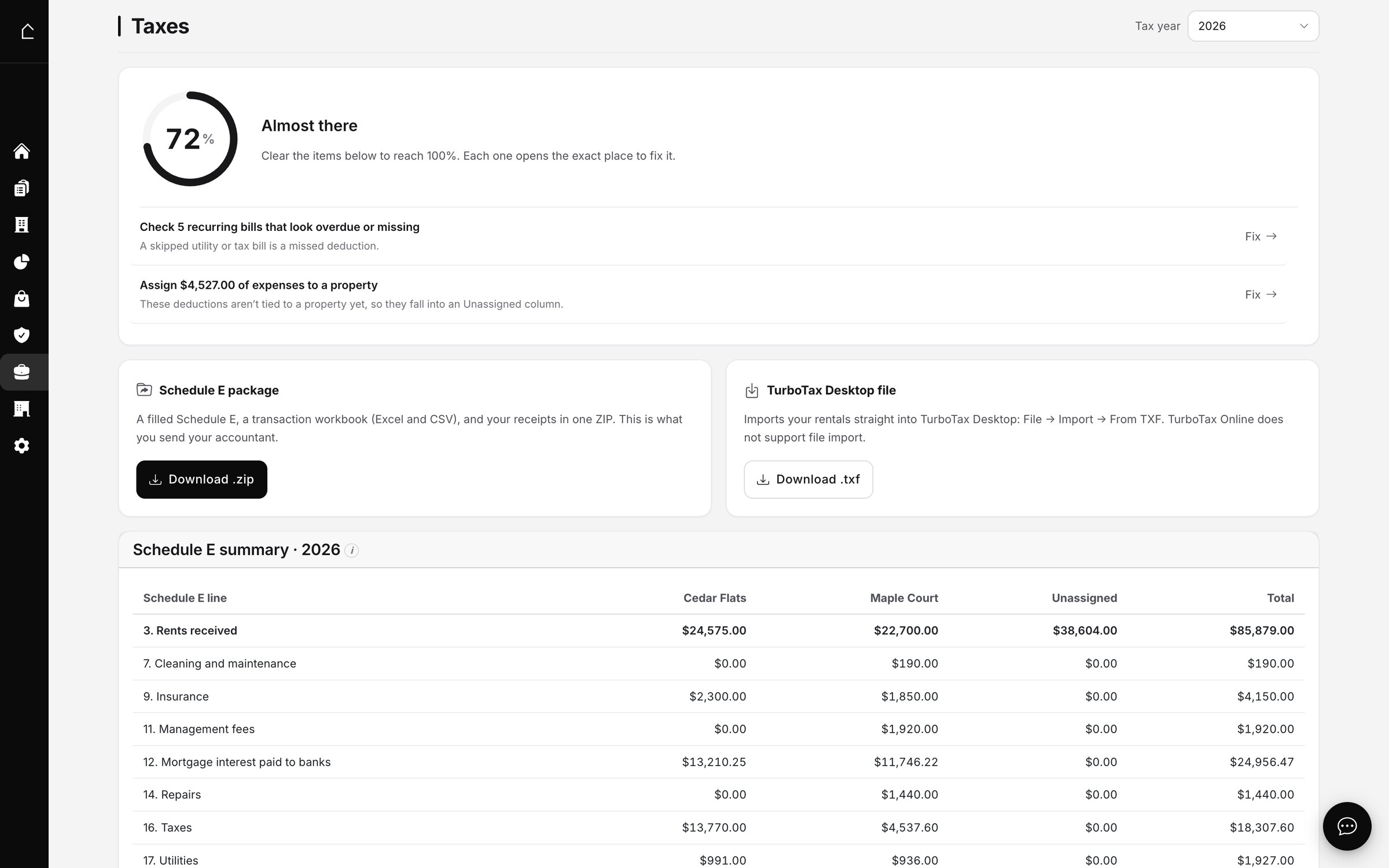
Prefer to build your own? The shape is not complicated: a payment log that splits four ways, an escrow ledger that tracks disbursements rather than deposits, and a check that the two add back to the debit. It is 2026, you can wire that together yourself.
This is one piece of the monthly routine. I wrote up the whole thing, the four monthly moves and the year-end return, in how I do the bookkeeping for both rentals in about a minute a month.