Free tool and download
Vacation home rental days: the 14-day rule and your deductions
A free calculator for a cabin, beach house or second home you rent out part of the year and use the rest. Count the days, and it tells you which rules apply: the rent is tax free, the deductions stop at the rent, or the place is a rental with no cap. Then it runs the expense limit in the order Publication 527 sets. No email, no signup.
The days
The whole home for the year
Educational estimate, federal only, not tax advice. Assumes all the mortgage interest is home mortgage interest and no casualty losses. Depreciation is a full year's straight line figure; the first year uses a mid-month table. Nothing you type here is stored.
- A day log with a Rented, Personal use, Repairs and upkeep or Vacant picker on every stay
- The test that picks the rules, and Worksheet 5-1 line by line with the carryovers to next year
- Where every amount goes: Schedule E, Schedule A, or nowhere, and a sheet of common traps
The three sets of rules for a home you rent and use
Two numbers decide everything: the days the home was rented at a fair rent, and the days of personal use. The home counts as used as a home when the personal days go over the greater of 14 days or 10% of the rental days. From there it is one of three cases:
| The year | The rules | On Schedule E |
|---|---|---|
| Used as a home, rented 14 days or fewer | The rent is tax free | Nothing. Interest and taxes go on Schedule A |
| Used as a home, rented 15 days or more | Split by days, capped at the rent | Up to the rent; the rest carries forward |
| Not used as a home | Split by days, no cap | All of the rental share; a loss is possible |
The rental percentage is the rental days over the total days used. Days the home sat empty, even listed, count on neither side, and so do days you spent substantially full time on repairs.
A worked year
A lake cabin is rented 120 days for 24,000 and the owners use it 30 days. The limit is the greater of 14 days or 12 (10% of 120), so 30 personal days make it a home, and the rental percentage is 120 of 150 days, 80%. Publication 527's Worksheet 5-1 then deducts in a fixed order:
| Worksheet 5-1 | Whole home | Rental share | Allowed |
|---|---|---|---|
| Rents received | 24,000.00 | ||
| Mortgage interest | 10,000.00 | 8,000.00 | 8,000.00 |
| Real estate taxes | 5,000.00 | 4,000.00 | 4,000.00 |
| Direct rental costs (booking fees, ads) | 3,000.00 | 3,000.00 | 3,000.00 |
| Rent left for the rest | 9,000.00 | ||
| Operating costs | 10,000.00 | 8,000.00 | 8,000.00 |
| Depreciation on a 330,000 building | 12,000.00 | 9,600.00 | 1,000.00 |
| Net rental income | 0.00 |
Schedule E shows 24,000 of rent against 23,000 of expenses and 1,000 of depreciation. The other 8,600 of depreciation is not lost: it carries to next year, behind next year's costs. The owners keep 2,000 of interest and 1,000 of property tax for Schedule A.
How one day changes the answer
Run the same cabin with 14 personal days instead of 30. That is not over the limit, so the cabin is not a home this year: the rental percentage becomes 120 of 134 days, 89.55%, and nothing is capped. Expenses on Schedule E come to 25,387.50 and depreciation to 10,746.00, a net of (12,133.50). Sixteen fewer nights at the lake turn a zero into a loss.
That loss still has to clear the passive loss rules, and the personal share of the interest, 1,045.00, is generally not deductible anywhere, because a place you barely use is not your second home for the interest deduction. The property tax share, 522.50, still goes on Schedule A. When the average guest stays 7 days or less, the short-term rental rules decide whether a loss can be used.
What counts as a personal use day
- Any day you or your family use it, unless the family member pays a fair rent and it is their main home.
- Any day it is rented for less than a fair rent, to anyone.
- Any day under a swap, where you get the use of another home in return, and any day you donate it for a charity auction.
- Not a day of repairs, when you work on the home substantially full time, even if others come along.
Write the days down as they happen. The day log in the workbook adds them up and fills in the two numbers Schedule E line 2 asks for.
The 14-day rule
When the home is used as a home and rented 14 days or fewer, the rent is not reported at all, and the rental costs are not deducted. Your mortgage interest and property tax stay on Schedule A as usual. It is the same rule behind the Augusta rule. One more booked night makes the whole year's rent taxable and starts the split, so count before you accept a fifteenth day.
Where the numbers go next
The Schedule E amounts slot into the Schedule E worksheet, with the fair rental and personal use days on line 2. If the home is not a home this year and shows a loss, the rental loss deduction calculator shows how much of it you can use. For the depreciation figure in the first year, the depreciation calculator applies the mid-month table.
Frequently asked questions
What is the 14-day rule for a vacation home?
If you use the home as a home and rent it for 14 days or fewer in the year, the rent is not reported and the rental costs are not deducted. Mortgage interest and property tax stay on Schedule A. Rent it a fifteenth day and the whole year's rent is taxable.
When does a vacation home count as used as a home?
When your personal use days go over the greater of 14 days or 10% of the days it was rented at a fair rent. Rented 120 days, the limit is 14; rented 200 days, it is 20. Over the limit, deductions stop at the rent and the rest carries to next year.
How do I split expenses between rental and personal use?
Divide the days rented at a fair rent by the total days the home was used, rented plus personal. Days it sat empty count on neither side. Apply that percentage to the interest, taxes, insurance, utilities, repairs and depreciation. Costs only for renting, like booking fees, are not split.
Can I deduct a loss on a vacation home I also use?
Not while it counts as used as a home: deductions stop at the rent, and the operating costs and depreciation that do not fit carry forward. Keep personal use within the limit and the cap goes away, though the loss still has to clear the passive loss rules.
What counts as a personal use day?
Any day you or a family member use it, unless the relative pays a fair rent and lives there as their main home. Any day it is rented below a fair rent, swapped for another home, or donated. A day spent working on the home substantially full time does not count.
In what order are vacation home expenses deducted?
Publication 527's Worksheet 5-1 sets the order: the rental share of mortgage interest and property tax plus direct rental costs first, then the rental share of operating costs, then depreciation last. Only what the rent can cover is deducted; the rest carries to next year.
How I do this in Oberlin24
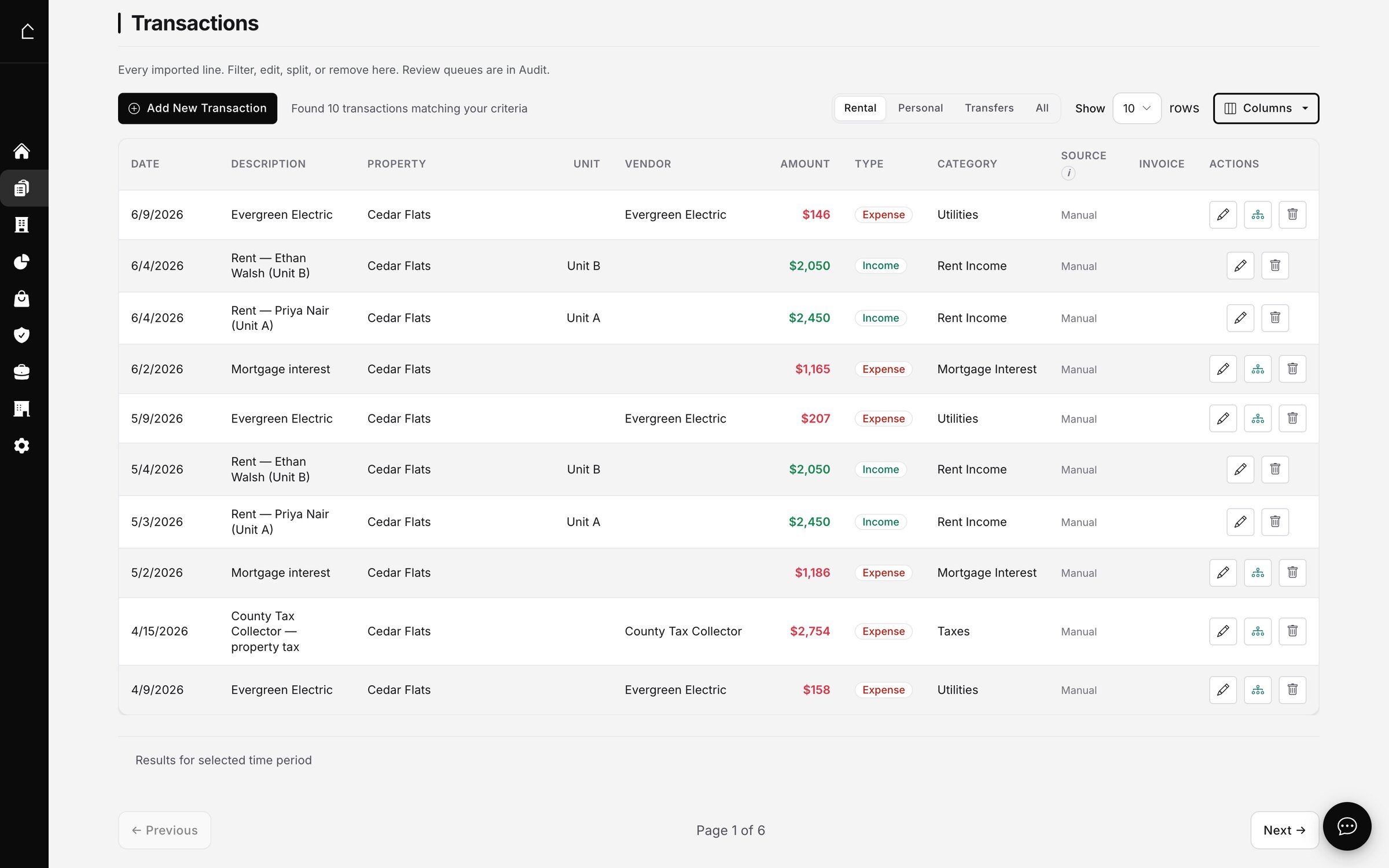
In Oberlin24 a vacation home is a property like any other. The bank feed puts its charges on it, and a shared bill I split once, rental share to the property and the rest left as personal, keeps splitting that way with Always split this way. The day count lives in this workbook; I bring the rental percentage over once a year.
Prefer to keep your own? The workbook above is the whole method: a day log, the test, and Worksheet 5-1 with the carryovers.
This is one piece of the monthly routine. I wrote up the whole thing, the four monthly moves and the year-end return, in how I do the bookkeeping for both rentals in about a minute a month.