Free download
Form 8582 worksheet
A free Form 8582 worksheet in Excel, laid out on the 2025 form: Parts I, II and III with every total a live formula, and the activity detail on the sheets the 2025 form calls Parts IV and V. It answers the one question the form exists for, which is how much of this year's rental loss you actually get to deduct. No email, no signup.
- Parts I, II and III in form order, with lines 1d, 2d, 3, 4, 7, 8, 9, 10 and 11 calculating themselves
- Parts IV and V on their own sheets, feeding lines 1a to 1c and 2a to 2c so the two cannot disagree
- The $25,000 special allowance and its phase-out, and the allocation chain that says which property each allowed dollar belongs to
Educational worksheet, not the filed form and not tax advice. Confirm your specific situation with your CPA.
The form that decides whether your loss counts this year
A rental can lose money on paper and still leave you owing tax. Depreciation is the usual reason: the building writes itself off over 27.5 years whether or not anything went wrong, so a property that covered its own costs in cash can finish the year with a loss on Schedule E. Form 8582 is where that loss meets the passive activity rules and finds out whether it is deductible now or suspended until later.
Most landlords get some of it. Rental real estate you actively participate in qualifies for a special allowance of up to $25,000, and active participation is a low bar: own at least 10% and make management decisions such as approving tenants, setting rents and authorizing repairs. You do not have to swing the hammer or answer the phone yourself.
The catch is income. The allowance drops by 50 cents for every dollar of modified adjusted gross income above $100,000 and is gone at $150,000. A landlord earning $130,000 gets $10,000 of it, not $25,000. Nothing you do with the bookkeeping changes that, which is why it is worth knowing the number before you file rather than after.
The 2025 form moved the worksheets onto the form
If you are working from a worksheet you built last year, or from one of the free ones still circulating, check the structure before you trust it. On Form 8582 (2025) the worksheets that used to sit in the instructions are printed on the form itself as Parts IV through IX, and Part I now reads from them by name.
| Where the detail used to go | Where it goes now |
|---|---|
| Worksheet 1, rental real estate with active participation | Part IV. Lines 1a, 1b and 1c read its columns (a), (b) and (c) |
| Worksheet 2, all other passive activities | Part V. Lines 2a, 2b and 2c read its columns (a), (b) and (c) |
| Worksheet 3, commercial revitalization deductions | Off the form. Line 3 now subtracts any prior year unallowed CRD instead |
| Worksheet 4, if an amount is shown on Part II line 9 | Part VI |
| Worksheet 5, allocation of unallowed losses | Part VII |
| Worksheet 6, allowed losses | Part VIII |
| Worksheet 7, losses on two or more forms or schedules | Part IX |
Part I carries a new caution to match: complete Parts IV and V before completing Part I. The detail is filled first now. Line 3 also picked up wording, reading "Combine lines 1d and 2d and subtract any prior year unallowed CRD", and the routing off a line 2d loss sends you to line 10 where the older form said Part III.
Signs are how this form goes wrong
Lines 1b, 1c, 2b and 2c are printed inside parentheses, which means you enter the loss as a positive number and the form subtracts it. Part II says it outright: enter all numbers in Part II as positive amounts. Half the arithmetic mistakes on this form are someone entering a loss as a negative into a line that was already going to subtract it, then wondering why the answer doubled.
This worksheet follows the printed form rather than inventing its own convention, and every entry cell says which sign it wants.
A worked year
Two rentals and a limited partnership interest. Rental A nets $3,000. Rental B loses $18,000 and carries $4,000 of loss suspended from last year. The partnership loses $2,000. Modified AGI is $120,000.
Line 1d combines the rental figures to a $19,000 loss. Line 2d is the partnership's $2,000. Line 3 is a $21,000 loss, so Part II applies. MAGI is $30,000 below the $150,000 line, half of that is $15,000, and that is the allowance. Line 9 takes the smaller of the $19,000 rental loss and the $15,000 allowance. Line 10 adds the $3,000 of passive income, which absorbs loss before the allowance is needed at all. Line 11 allows $18,000 this year and suspends the rest to next.
Change MAGI to $150,000 in the same worksheet and line 11 falls to $3,000: the income still absorbs its share and the allowance is gone. That single cell is usually the whole conversation.
Married filing separately
Two different answers, and which one you get turns on where you lived. Filing separately while living apart from your spouse for the entire year halves everything: $75,000 on line 5 instead of $150,000, and a $12,500 cap on line 8 instead of $25,000. Filing separately having lived with your spouse at any point during the year removes the special allowance completely. Do not complete Part II at all in that case; go to line 10.
What suspends does not disappear
A loss this form disallows is not lost. It carries forward, and it comes back on line 1c or 2c next year as a prior years' unallowed loss. If the property eventually turns a profit, the suspended losses offset it. If you sell the property in a fully taxable disposition to an unrelated party, the whole suspended balance for that activity releases at once, which is the part people discover too late to plan around. That release is often larger than the gain it lands next to, and it is a good reason to run the numbers before agreeing a sale date rather than after. Our sell, hold or 1031 calculator includes it.
Keeping the running balance per property is the actual work, and it is the thing a shoebox of receipts cannot tell you in March. Carry it forward year to year with the rest of the file.
Your filing set, free
This form sits downstream of the books. The Schedule E worksheet is where the year's rents and costs land first and where the loss on line 1b comes from, and the rental loss deduction calculator answers the allowance question on its own if that is all you came for. Behind both: the chart of accounts so every expense lands on one line and stays there, the depreciation schedule template for the write-off that usually creates the loss in the first place, and the repair or improvement decision tool for the calls that decide whether a cost hits this year at all.
Frequently asked questions
What is Form 8582 used for?
Did Form 8582 change for 2025?
Who qualifies for the $25,000 special allowance?
What happens to a rental loss that Form 8582 disallows?
Do the loss lines take positive or negative numbers?
What if I am a real estate professional?
How I do this in Oberlin24
My own two properties run a loss most years, and the loss is depreciation rather than anything going wrong. What makes this form fillable is upstream of it: the bank feed sorted to one line per cost, the mortgage split so only the interest counts, improvements held out of repairs, and the depreciation actually booked. Get those right and Part IV is a copy job. Here is the view the totals come from:
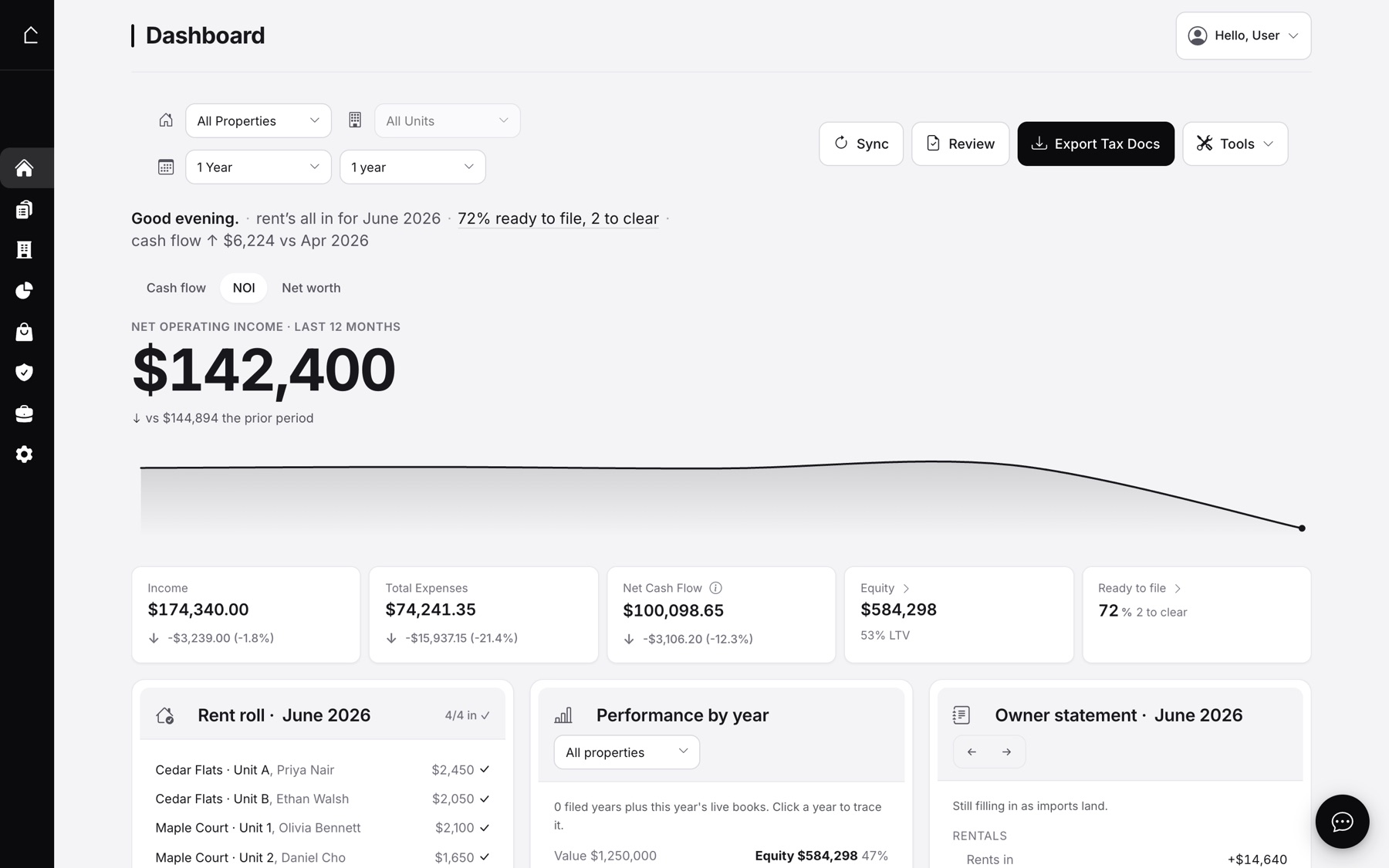
Prefer to keep your own? It is a bank feed, one line per cost, and a suspended-loss balance carried forward per property. The worksheet above is the shape.
This is one piece of the monthly routine. I wrote up the whole thing, the four monthly moves and the year-end return, in how I do the bookkeeping for both rentals in about a minute a month.