Free download
Form 8825 worksheet
A free Form 8825 worksheet in Excel, laid out on the December 2025 revision of the form: four property columns, lines 2a through 23, and a second sheet for the new Schedule A that replaced the write-in line. Every total is a live formula. No email, no signup.
- Four property columns in form order, with lines 2c, 18, 19, 20a, 20b and 23 calculating themselves
- Schedule A (Form 8825) on its own sheet, all twenty named categories, feeding line 17 so the two cannot disagree
- The line 1 code lists, both of them, including the acquisition codes that are new this revision
Educational worksheet, not the filed form and not tax advice. Confirm your specific situation with your CPA.
Same books, different form
Hold a rental in your own name and the year ends on Schedule E. Move it into a multi-member LLC, a partnership or an S corporation and the same year ends on Form 8825, attached to the 1065 or the 1120-S. Nothing about the bookkeeping changes. Rent is still rent, a repair is still a repair, and mortgage principal is still not an expense. What changes is the sheet of paper the totals land on, and the numbering on that sheet is not the numbering you learned on Schedule E.
This worksheet is the Schedule E worksheet's entity sibling. Fill the white cells property by property and the totals walk themselves down to line 23, which is the one number that leaves the form.
The December 2025 revision renumbered almost everything
If you are working from a worksheet, a blog post or last year's file, check the line numbers before you trust them. The current form is Form 8825 (Rev. December 2025), and six things moved.
| What changed | Where it is now |
|---|---|
| Rental income split in two | 2a gross rents, 2b other income related to the activity, 2c the total |
| Wages and salaries | Line 13, on its own |
| Depreciation | Line 14 |
| Lines 15 and 16 | Reserved for future use. Leave them blank |
| The old write-in "other" line | Line 17, totalled on the new Schedule A (Form 8825) |
| Column (c) of line 1 | New acquisition and disposition codes, A through I |
The totals renumbered too. Rental income across the properties is 20a, expenses across the properties is 20b, a Form 4797 gain or loss is 21, income flowing in from another entity's K-1 is 22a, and line 23 combines them and goes on Schedule K, line 2.
Schedule A (Form 8825) is the part people miss
The write-in line is gone. Other deductions now sit on line 17 and, for a partnership or S corporation with a Schedule M-3 filing requirement, they are itemized on a Schedule A (Form 8825) for each property. The schedule names twenty categories: asset management fee, bad debt expense, building maintenance, common charges, contract services, debt extinguishment costs, ground rent, grounds maintenance, homeowner association fee, incentive fee, landscaping, leased employee expense, management fee, other taxes, prepayment penalty, reimbursed wages and salaries, Section 481(a) adjustments, tenant renovations, tenant services and turnover expenses, with anything left over on line 30.
The second sheet of this worksheet is that schedule, and its total is what line 17 reads. If a cost already has a line on the face of Form 8825, insurance or repairs or utilities, it belongs there rather than here. Sorting other deductions this way is useful even when the M-3 requirement does not reach you: it is how the IRS now expects the category to be broken out, and it is easier to do as the year goes than in one sitting in March.
What is not on this form at all
Two things a landlord expects to find and will not. Mortgage principal is nowhere on Form 8825, because repaying a loan is not a deduction: only the interest on line 8 is. And a capital improvement is not an expense line either. A new roof reaches the form as depreciation on line 14, spread over its own life, which is why the repair or improvement decision tool and the depreciation schedule template are worth running before you fill line 11 and line 14.
Fair rental days and personal-use days still matter
Line 1 asks for both, per property, and they are not decoration. Personal use by a partner, a shareholder or their family can limit the deductions for that property and can turn a rental into a mixed-use property for the year. Record the two counts as they happen. Reconstructing them from a calendar eleven months later is the part nobody can do well.
Your filing set, free
This covers the entity return. If you hold anything in your own name as well, the Schedule E worksheet lays that out in its own form order. Behind both sit the working papers: the profit and loss template for the year's performance, the cash flow statement template for where the money actually went, the rent roll template for what line 2a is made of, and the chart of accounts so every expense lands on one line and stays there.
Frequently asked questions
What is Form 8825?
Form 8825, Rental Real Estate Income and Expenses of a Partnership or an S Corporation, is where an entity reports the income and deductions from its rental real estate. It attaches to Form 1065 or Form 1120-S and holds four properties per page. It is the entity version of Schedule E: the same rents and the same costs, on different line numbers, ending at line 23 which carries to Schedule K, line 2.
Who files Form 8825 instead of Schedule E?
Partnerships, multi-member LLCs taxed as partnerships, and S corporations. If you own a rental in your own name, or through a single-member LLC that is disregarded for tax, you stay on Schedule E of your 1040. The moment the property sits inside an entity that files its own return, the rental activity moves to Form 8825 and reaches you on a K-1 rather than directly on your Schedule E.
What changed on Form 8825 in the December 2025 revision?
Six things, and they renumber most of the form. Line 2 splits into 2a gross rents and 2b other income, totalling on 2c. Wages and salaries get line 13 and depreciation moves to line 14. Lines 15 and 16 are now reserved for future use, so nothing goes on them. The old write-in other line becomes line 17, itemized on the new Schedule A (Form 8825). Column (c) of line 1 is a new acquisition or disposition code. And the totals renumber to 20a, 20b, 21, 22a and 23. Any worksheet built on the older layout will put figures on the wrong lines.
Do I have to attach Schedule A (Form 8825)?
It is required for a partnership or S corporation with a Schedule M-3 filing requirement, which generally means larger entities. Everyone else reports other deductions on line 17 without the attachment. The schedule is still worth using either way: it names twenty categories the IRS now expects, from asset management fee through turnover expenses, and sorting other deductions that way during the year is far easier than reconstructing them at filing time.
Where does Form 8825 line 23 go?
Line 23 is the net rental real estate income or loss, and it goes on Schedule K, line 2, of Form 1065 or 1120-S. From there it is allocated to the partners or shareholders and shows up on each K-1, where it keeps its character as rental real estate income. It is the only figure that leaves the form, which is why it is worth checking that the properties above it foot.
Is mortgage principal deductible on Form 8825?
No. Only the interest is, on line 8. The principal slice of a mortgage payment repays a loan and buys equity, so it appears nowhere on Form 8825, exactly as it appears nowhere on Schedule E. If your books are recording the whole payment as an expense, the entity's deduction is overstated by the principal every month, which is the most common error behind an 8825 that does not tie to the bank.
Where do capital improvements go on Form 8825?
Not on an expense line. A new roof, an addition or a whole HVAC system is capitalized and reaches the form as depreciation on line 14, spread over its own recovery period. Line 11, Repairs, is for costs that keep the property in ordinary operating condition. Getting the split wrong in either direction is a deduction in the wrong year, and the IRS BAR test is what decides it.
How I do this in Oberlin24
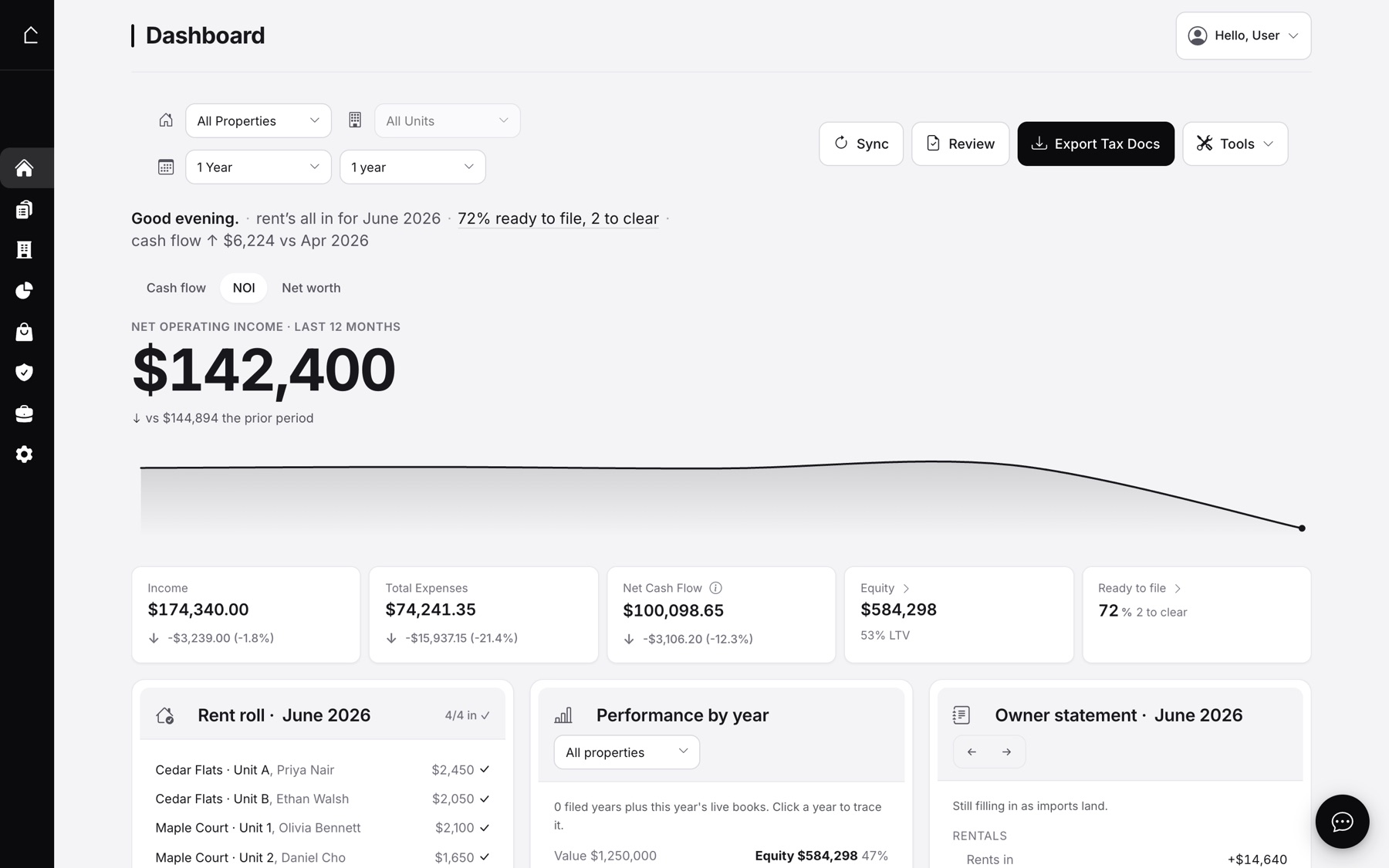
My own two properties are on Schedule E, not on an 8825, so the app files them that way. The part that carries over either way is what sits underneath: the bank feed categorized to a fixed set of lines, the mortgage payment split so only the interest counts as an expense, and improvements held out of repairs. Whichever form the year lands on, that is the work. Here is the view the totals come from:
Prefer to keep your own? It is a bank feed, one line per cost, and the discipline to keep principal and improvements out of expenses. The worksheet above is the shape.
This is one piece of the monthly routine. I wrote up the whole thing, the four monthly moves and the year-end return, in how I do the bookkeeping for both rentals in about a minute a month.