Free download
Rental property cash flow statement template
A free rental property cash flow statement template: what came in, what went out, and the month it left, with 12 columns that total themselves. A second sheet bridges Schedule E line 21 to the same number and checks its own work. No email, no signup.
- 12 month columns plus a year total, all live formulas
- Deposits, principal, improvements and owner money kept where they belong, out of income and out of expenses
- A reconciliation sheet that turns taxable income into cash and shows a zero when the two agree
Educational template, not tax or accounting advice. Confirm your specific situation with your CPA.
Profitable on paper, empty in the account
A rental can show a profit on the return and leave you shorter than you started, or show a loss and put money in your pocket. Neither is an error. A profit and loss statement answers what the property earned. This one answers where the cash went, and the gap between the two is always the same five items.
| Item | On the return | In the account |
|---|---|---|
| Depreciation | Deducted on line 18 | Nothing leaves |
| Mortgage principal | Not deductible at all | Cash out every month |
| Capital improvements | Deducted over 27.5 years | Cash out the day you pay |
| Security deposits | Not income, not an expense | Cash in, then cash out later |
| Owner contributions and draws | Neither, they are your money moving | Cash in and cash out |
Every one of those is a place where a landlord reading a tax return gets the wrong answer about their own bank balance. The template keeps them on separate rows and labels each with what it is, so nothing quietly lands in the wrong column.
The second sheet checks its own work
Cash vs taxable starts at net income or loss, Schedule E line 21, then adds depreciation back, takes out principal and improvements, and puts deposits and owner money where they belong. The last row subtracts the answer from the cash flow sheet's own total and should read zero. If it does not, one of the two sheets is wrong, and you find that out while it is still fixable rather than in April.
Only one cell on that sheet is typed: depreciation for the year, which comes off your schedule. If you have never built one, the depreciation schedule template lays it out asset by asset and the depreciation calculator computes the first year from your purchase details.
Fill one column a month
A year of cash flow built in one sitting in April is a reconstruction, and the pattern it hides is the useful part: the month insurance renews, the quarter the taxes hit, the repair streak that should have been one capitalized project. A column a month, off statements you have reconciled to the bank, keeps the statement honest and makes the next one faster.
Cash flow, NOI and net income are three different numbers
NOI is income minus operating expenses, before financing and before depreciation, which is what a lender or a cap rate is asking about. Net income subtracts mortgage interest and depreciation and is roughly what lands on line 21. Cash flow is this sheet: everything that moved, including the principal that builds equity and the improvements that do not deduct this year. Quoting one when you mean another is how a property gets bought or sold on the wrong number. The ROI calculator works from the cash figure; the NOI walkthrough covers the first.
Your statement set, free
This covers cash over a period. The profit and loss template covers performance over that same period, the balance sheet template covers what you own and owe on a date, and the rent ledger template holds the per-tenant history behind the rent row. At filing time the Schedule E worksheet lays the year out in form order.
Frequently asked questions
Why is my rental profitable on paper but there is no cash?
Five items separate the two numbers, and every one of them can run in your favour or against you. Depreciation is deducted without any cash leaving. Mortgage principal leaves every month and is not deductible at all. A capital improvement leaves the day you pay and deducts over 27.5 years. A security deposit arrives as cash that is not income, and goes back out as cash that is not an expense. Owner contributions and draws are neither. Put those five on their own rows and the gap stops being a mystery: the statement shows which of them ate the profit.
Is mortgage principal an expense?
No. The interest slice of the payment is deductible on Schedule E line 12; the principal slice buys equity in an asset you already own, so it never appears on a profit and loss statement. It is real cash out, which is why it belongs on a cash flow statement and nowhere on the return. This is the most common reason a landlord's books disagree with their bank.
Are security deposits income?
Not when you collect them. A deposit you may have to return is a liability you are holding, so it raises cash without raising Schedule E line 3, and returning it lowers cash without being an expense. Two things change that: a deposit you keep for unpaid rent or damage becomes income in the year you keep it, and a deposit taken as the last month's rent up front is rent, taxable when received. The template keeps the collected and returned rows separate so you can see the balance you are holding.
What is the difference between cash flow and NOI?
NOI is rental income minus operating expenses only, before the mortgage and before depreciation. It describes the property. Cash flow is everything that actually moved, so it subtracts the whole mortgage payment including principal, subtracts capital spending, and includes deposits and owner money. A property can have healthy NOI and negative cash flow in the year it needs a roof. Lenders and cap rates ask for NOI; your bank account answers cash flow.
Do capital improvements go on a cash flow statement?
Yes, in full, in the month you pay for them. That is the difference between this statement and a profit and loss: an $11,000 roof is $11,000 of cash out now and roughly $400 of depreciation a year on the return. Keeping it on its own row also stops the other common error, which is deducting the roof as a repair on line 14 and overstating this year's deduction.
How do I check that my cash flow statement is right?
Bridge it to the return and see if the bridge lands. Start at net income or loss on Schedule E line 21, add depreciation back, subtract mortgage principal and capital improvements, add deposits received, subtract deposits returned, then add contributions and subtract draws. The result has to equal the net cash flow you computed the other way. The second sheet of this template does that subtraction for you and prints the difference, so a zero is the proof and anything else names the year you need to look at again.
How I do this in Oberlin24
I do not keep this one by hand for my own two properties. The dashboard nets cash flow month by month straight off the bank feed, with the mortgage payment split so the principal slice counts as cash out and not as an expense, and the owner statement prints the month with the equity the principal built stated beside the cash. Here is the view it comes from:
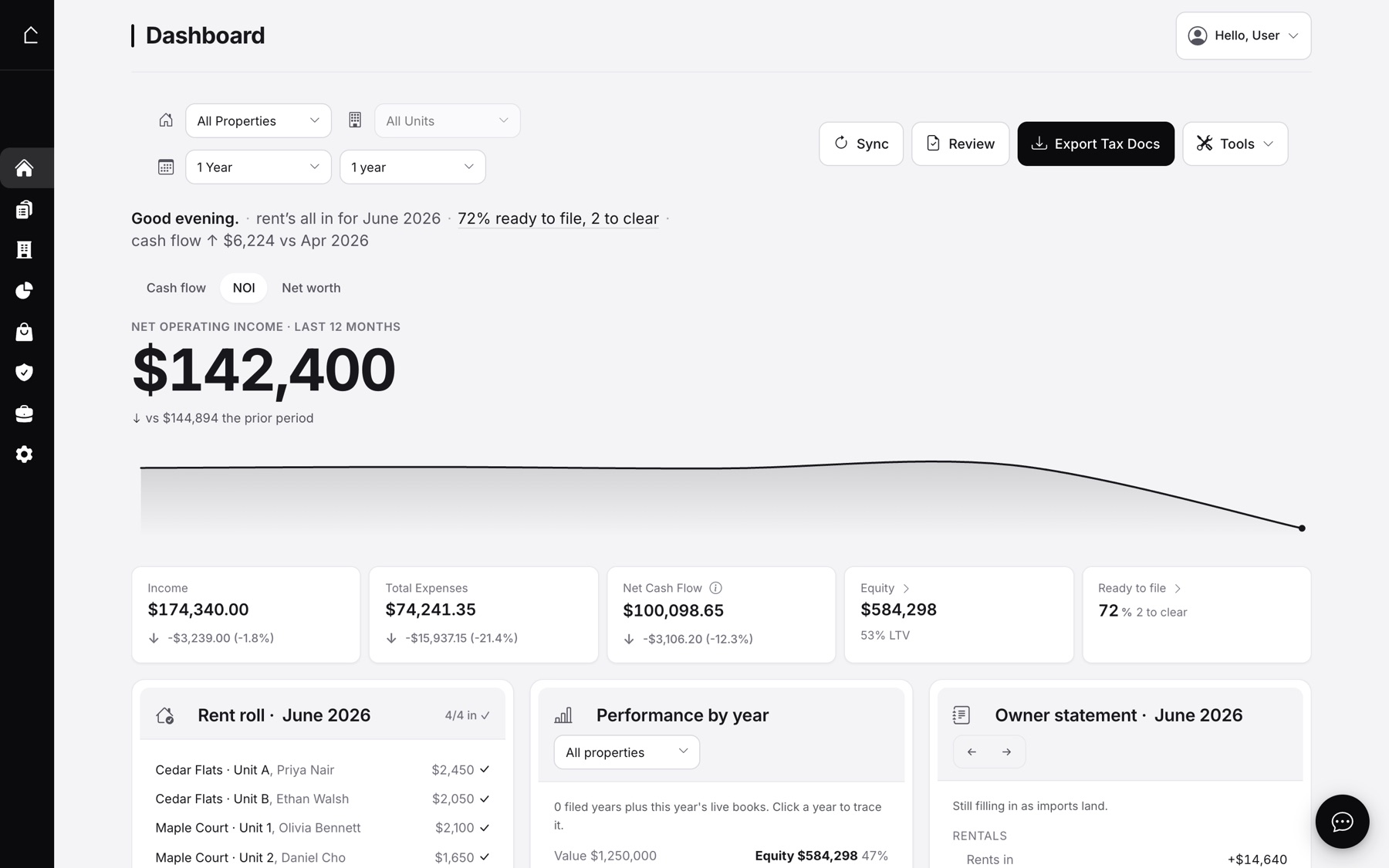
Prefer to keep your own? It is a bank feed, a mortgage payment split into interest and principal, and one column a month. The template above is the shape.
This is one piece of the monthly routine. I wrote up the whole thing, the four monthly moves and the year-end return, in how I do the bookkeeping for both rentals in about a minute a month.