Free download
Rental property profit and loss statement template
A free rental property profit and loss statement template with monthly columns that total themselves. Income, operating expenses, NOI, and pre-tax net income, and every expense row is labeled with the Schedule E line it lands on. No email, no signup.
- 12 month columns plus a year total, all live formulas
- NOI and net income calculated for you, with financing and depreciation broken out
- Every row mapped to its Schedule E line, so year-end filing is a transfer, not a project
Educational template, not tax or accounting advice. Confirm your specific situation with your CPA.
How the statement is organized
Top to bottom it answers three different questions, and keeping them separate is the whole point:
| Section | What it tells you |
|---|---|
| Income minus operating expenses | NOI: how the property performs before financing. The number cap rates and lenders care about |
| Minus mortgage interest and depreciation | Pre-tax net income: roughly what flows to Schedule E line 21 |
| The Sch E line column | Where each row lands on the form, so December-you thanks January-you |
The two lines that confuse every P&L
Mortgage principal is not an expense. The interest slice of your payment is (line 12), but the principal slice buys equity, so it never appears on a P&L. That is why a property can show positive net income while your bank account feels flat: the cash left, but it went into the loan balance, not an expense. If you want the where-did-the-cash-go view, that is a cash flow statement, not a P&L.
Depreciation is an expense with no cash attached. Roughly 1/27.5 of your building's cost, every year, deducted on line 18 whether or not anything left your account. It is the main reason a cash-positive rental can show a paper loss, the mechanism behind paying little or no tax on rental income. If you have never computed it, the depreciation calculator builds the schedule from your purchase details.
Monthly columns are the discipline
A year-end P&L built in one sitting is a reconstruction. Filling one column a month, off statements you have reconciled to the bank, is how the statement stays accurate. The monthly shape also shows you the pattern a single annual number hides: the month insurance renews, the summer utility bump, a repair streak that should have been one capitalized project.
Your three-statement set, free
This P&L covers performance over a period. The balance sheet template covers what you own and owe on a date, and the rent ledger template keeps the per-tenant payment history that backs up your income rows. Together they are the same three records a bookkeeper would keep, minus the invoice. At filing time, the Schedule E worksheet takes the year column and lays it out in form order.
Frequently asked questions
What is a profit and loss statement for a rental property?
A summary of one property's income and expenses over a period, usually a month or a year: rents in, operating expenses out, then financing and depreciation, ending at net income or loss. It answers how the property performed over time, where a balance sheet answers where you stand on a single date.
What should a rental P&L include?
Rental income (rent plus late fees and other income), the operating expenses (insurance, taxes, repairs, utilities, management, and the rest), net operating income, then mortgage interest and depreciation to reach pre-tax net income. This template also labels every row with the Schedule E line it maps to, which turns filing into a transfer instead of a sorting project.
What is NOI and why is it separate from net income?
Net operating income is income minus operating expenses, before any financing or depreciation. It measures the property itself, independent of how you financed it, which is why cap rates and lenders use it. Net income then subtracts mortgage interest and depreciation, and that is the number that approximates your Schedule E bottom line.
Does mortgage principal go on a profit and loss statement?
No. Only the interest portion of your mortgage payment is an expense. Principal repayment builds equity and belongs on the balance sheet, not the P&L. This is the most common landlord P&L error, and it is why a property can show a profit while the bank account barely moves.
Why is depreciation on the P&L if no cash left my account?
Because it is a real tax deduction: roughly 1/27.5 of the building's cost every year for residential rentals. Including it shows your taxable result, not just your cash result, and it is the main reason a cash-flow-positive rental can report a paper loss. Leave it off and your P&L overstates what you will owe tax on.
Does this template work in Excel and Google Sheets?
Yes. It is a standard XLSX with plain SUM and subtraction formulas, so it opens in Excel and Numbers directly and converts cleanly to a Google Sheet. Use one copy per property per year; the month columns, year total, NOI, and net income are all live formulas.
How I do this in Oberlin24
I do not fill this one in by hand for my own two properties. In Oberlin24 the P&L builds itself from the bank feed: every charge categorized to these exact Schedule E lines, month by month, reconciled to my statements. When I want the finished statement, I export it as a profit-and-loss CSV in one click. Here it is, built from real books:
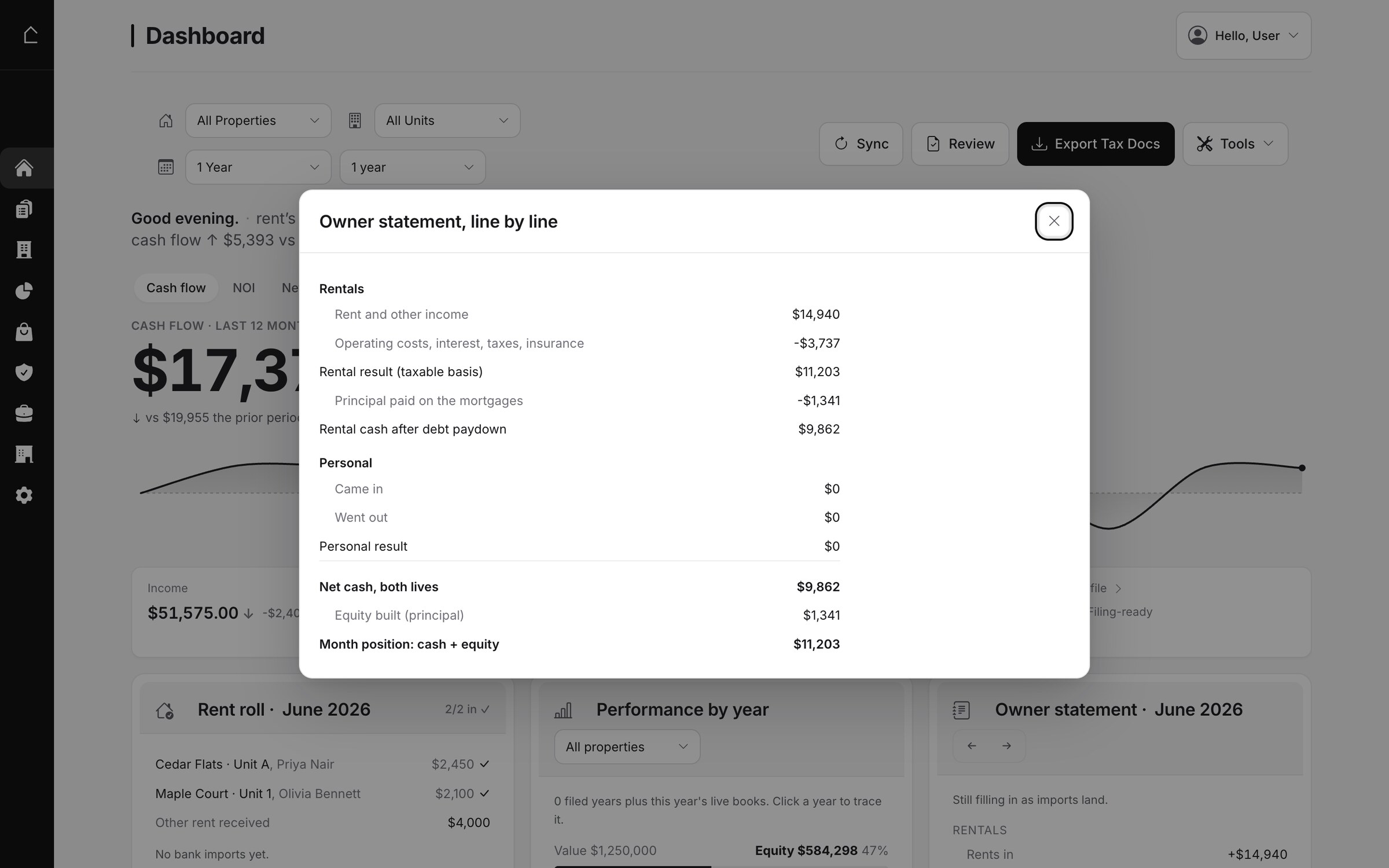
Prefer to build your own? It is a bank feed, one category per line, and a monthly pivot. Doable in a weekend if you enjoy that sort of thing.
This is one piece of the monthly routine. I wrote up the whole thing, the four monthly moves and the year-end return, in how I do the bookkeeping for both rentals in about a minute a month.