Free download
Landlord 1099-NEC contractor tracker
A free tracker for the one January job you cannot do from memory: which contractors crossed the reporting line, and whose W-9 you never collected. Log payments as you make them, and the second sheet answers who gets a 1099-NEC. Built for the 2026 threshold, which is $2,000, not $600. No email, no signup.
- Payment log: date, contractor, property, what it was for, amount, how you paid
- Per-contractor totals that exclude card and payment-app money, because a processor already reports that
- A plain answer per contractor, plus what is still missing before you can file
Educational template, not tax advice. It prepares the numbers; filing is yours or your CPA's. Confirm your own facts with your CPA.
The threshold moved for 2026, and most templates still say $600
For payments made in calendar year 2026, the reporting floor for Form 1099-NEC is $2,000 per payee, not the $600 that has been on every checklist since 1954. The One Big Beautiful Bill Act (P.L. 119-21, section 70433) raised it in July 2025, for reporting under sections 6041 and 6041A and for backup withholding alike, and from 2027 it indexes for inflation in $100 steps. The IRS carries the new figure in its draft W-9 instructions. So a 2026 tracker built on the old number tells you to chase W-9s and file forms for people nobody is owed a form for. The threshold in this template is a single cell on the Payments sheet; change it and every answer recomputes, which is how a later year should work.
One thing the change does not touch: the contractor still owes tax on every dollar. A payment under the threshold is unreported, not untaxed, and it is still a deduction on your Schedule E.
Does a landlord have to file 1099s at all?
It depends on whether your rental is a trade or business, and that is genuinely a judgment call rather than a rule you can look up. The requirement in section 6041 applies to payments made "in the course of your trade or business." For one year there was no ambiguity: the Small Business Jobs Act of 2010 added section 6041(h), which deemed anyone receiving rental income to be in that trade or business. Congress repealed it in April 2011, so landlords went back to the facts-and-circumstances test.
In practice the line follows how you already treat the activity. Several properties, active management, a real operation: that is a trade or business and the filings come with it. One condo held passively, a property manager doing everything: much weaker. The clarifying question is what you claim elsewhere on the return. If you take the qualified business income deduction on the rental, you are asserting the rental is a trade or business; declining to file the information returns that go with that position is hard to explain later. Being on the wrong side is cheap to fix and expensive to ignore, because the penalty runs per form and doubles for intentional disregard.
Who gets one, and who does not
| Gets a 1099-NEC | Does not |
|---|---|
| The handyman, plumber, painter, landscaper you paid $2,000 or more in 2026 | Anyone under $2,000 for the year, counted across every job |
| An unincorporated LLC, a sole proprietor, a partnership | Most corporations, including S corps, which is why the W-9 asks the entity type |
| Your attorney, even if the firm is incorporated | Payments for goods: appliances, lumber, a new water heater you bought yourself |
| A property manager's fee, and commissions you paid out | Rent you paid to someone, and your mortgage, insurance and utility bills |
| Labor and materials on one contractor invoice, reported in full | Anything you paid by card or a payment app (see below) |
The corporate exemption is the one people get backwards in both directions. It is real, and it is why the tracker has a Corporation column, but you only know the answer from the W-9. Guessing from a name fails constantly: "Sierra Roofing Inc" is a safe read, "Valley Plumbing LLC" tells you nothing, because an LLC can be taxed as a sole proprietorship, a partnership, or a corporation. The form asks; that is the whole point of collecting it.
How you paid changes the answer
Money that moves over a card network or a third-party payment app is reported by the processor on a Form 1099-K, and it is not yours to report a second time. Put it on your 1099-NEC and the contractor's income is double-counted on the IRS's side of the ledger, which is a letter neither of you wants. So a $2,300 contractor who took $900 of it on your credit card has a reportable total of $1,400, and files nothing.
Zelle is the trap on the other side. It looks like an app and it moves bank to bank, so no 1099-K exists for it and Zelle payments count in full toward your threshold. Checks, ACH transfers and cash count too. That is why the log asks how each payment was made rather than making you reconstruct it in January; the tracker's per-contractor total already leaves card and app money out.
Get the W-9 before you pay, not in January
A Form W-9 collects the contractor's legal name, entity type, address and taxpayer ID: everything a 1099-NEC needs and everything that decides whether one is owed. Ask for it before the first check clears, when you still have leverage. Ask in January, after the work is done and the contractor has moved on, and you find out how many phone numbers stop answering.
If you never get one, you are supposed to back up withhold 24% of further payments and send it to the IRS, which is unpleasant enough that collecting the form up front is simply the cheaper path. Keep the signed W-9 itself somewhere private. The tracker deliberately does not have a field for the taxpayer ID, only a marker that you hold it, because a spreadsheet that syncs to a phone and gets emailed to a bookkeeper is the wrong home for a contractor's Social Security number.
Deadlines, and what filing actually involves
Both copies of a 1099-NEC are due on the same day: the contractor's copy and the IRS's, by January 31 following the tax year. When that falls on a weekend it moves to the next business day, so the 2026 forms are due Monday, February 1, 2027. There is no automatic extension the way there is for some other forms. Penalties are charged per form on a sliding scale that depends on how late the form is, and the top tier, intentional disregard, is both the largest and uncapped, which is what makes ignoring the question worse than getting the answer wrong. The current figures are in the general instructions for information returns.
File electronically if you are filing 10 or more information returns of all types combined, which is the current threshold and counts your 1099s, W-2s and the rest together. The IRS's IRIS Taxpayer Portal is free and takes a small landlord's handful of forms directly. Most CPAs will file them with the return package; the part they need from you is exactly this tracker, filled in.
Where this sits in the rest of the books
Every payment in this tracker is also a deduction. Repairs land on Schedule E line 14, cleaning and maintenance on line 7, management fees on line 11, legal and professional on line 10, and a contractor invoice that turns out to be a capital improvement leaves Schedule E's expense lines entirely for depreciation on line 18. So the same list does two jobs, and it is worth keeping in one place: the Schedule E worksheet lays out the whole form, the rental property spreadsheet is the income and expense ledger this log rides alongside, and repair or improvement? settles the ones that could go either way.
Frequently asked questions
Do landlords have to issue 1099s to contractors?
It depends on whether your rental is a trade or business, which is a facts-and-circumstances test rather than a rule you can look up. For one year it was automatic: the Small Business Jobs Act of 2010 added section 6041(h), deeming anyone with rental income to be in that trade or business, and Congress repealed it in April 2011. So the answer now follows how you actually run the properties. Several units, active management, a real operation: file. One condo held passively with a manager doing everything: much weaker. The clarifying question is what you claim elsewhere on the return, because taking the qualified business income deduction on a rental asserts that the rental IS a trade or business, and declining the information returns that go with that position is hard to explain later.
What is the 1099-NEC threshold for 2026?
$2,000 per payee for payments made during calendar year 2026, up from the $600 that had stood since 1954. The One Big Beautiful Bill Act (P.L. 119-21, section 70433) raised the section 6041 and 6041A reporting floor, and the figure indexes for inflation in $100 increments from 2027. Payments below the threshold are still deductible to you and still taxable to the contractor; only the reporting form goes away.
Do I send a 1099 for contractors I paid by credit card or Venmo?
No. Card networks and third-party payment apps report those payments themselves on a Form 1099-K, so putting the same dollars on your 1099-NEC double-counts the contractor's income. Leave card and app payments out of the total you test against the threshold. Zelle is the exception that catches people: it moves bank to bank, nobody issues a 1099-K for it, so Zelle payments count in full. Checks, ACH and cash count too.
Do I have to send a 1099 to an LLC?
Usually yes. Corporations are generally exempt, but an LLC can be taxed as a sole proprietorship, a partnership, or a corporation, and the name tells you nothing. That is what the W-9 is for: it asks the entity type, and the answer decides. Two exceptions run the other way, attorneys and most medical payments, which get a 1099 even when the recipient is incorporated.
When are 1099-NEC forms due?
The contractor's copy and the IRS copy are both due January 31 following the tax year, with no automatic extension. When January 31 falls on a weekend the deadline moves to the next business day, so forms for 2026 payments are due Monday, February 1, 2027. File electronically if you are filing 10 or more information returns of all types combined; the IRS IRIS Taxpayer Portal is free and handles a small landlord's handful directly.
What if a contractor will not give me a W-9?
You are expected to begin backup withholding, currently 24%, on further payments to them and remit it to the IRS, which is unpleasant enough that collecting the form before the first check is simply the cheaper path. Ask when you still have leverage. Ask in January, after the work is done, and you learn how many phone numbers stop answering. Keep the signed W-9 itself somewhere private rather than in a spreadsheet that syncs to a phone and gets emailed to a bookkeeper.
The same three rules, run for you
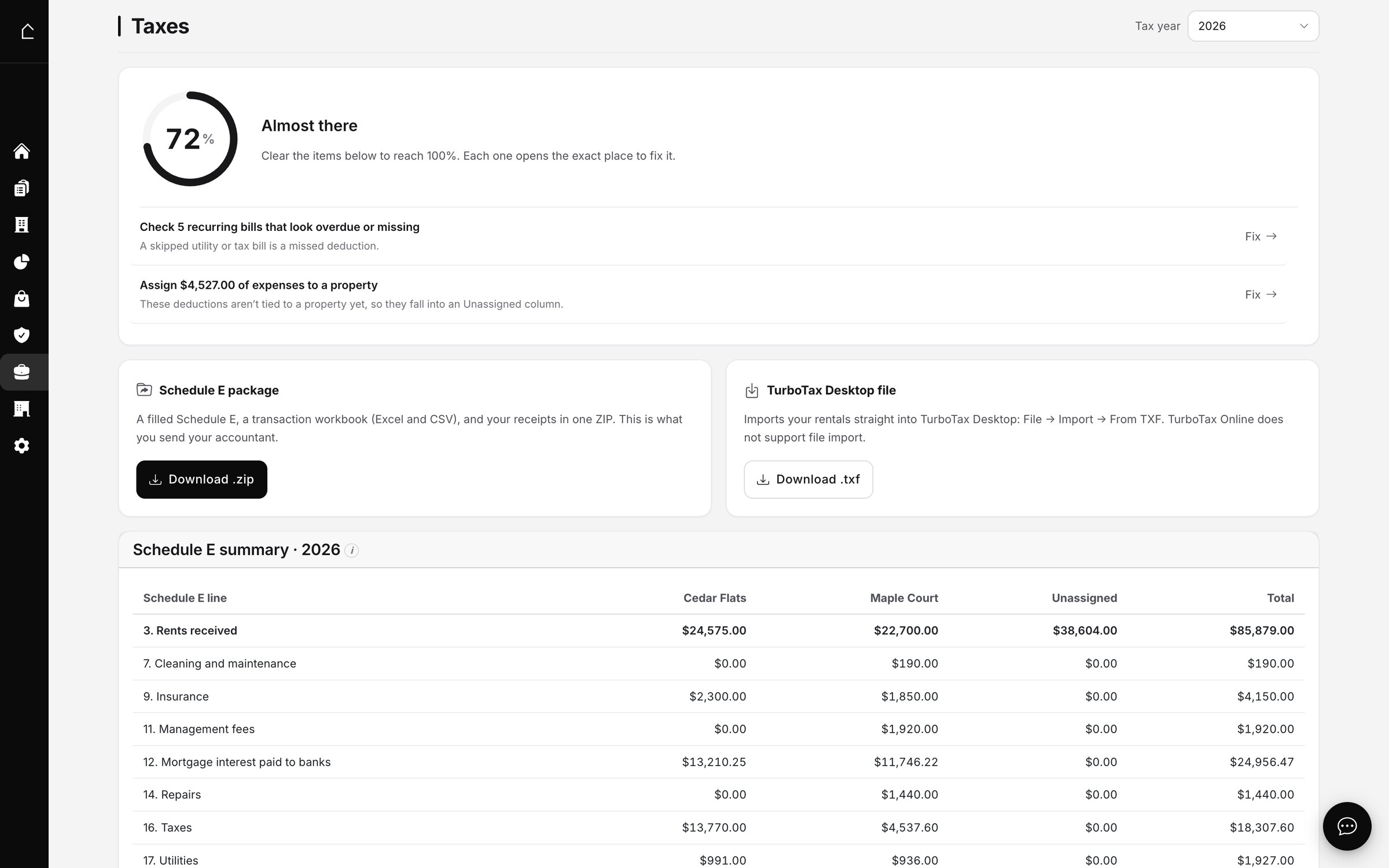
I run two rentals of my own, and the reason this template has a 'how you paid' column is that I got the answer wrong by hand first. Oberlin24's Contractor 1099s card runs the same three rules against the books directly: the threshold keyed to the year (600 through 2025, 2000 from 2026), card and payment-app lines excluded because the processor reports them while Zelle counts, and the corporate exemption read off the W-9 entity type rather than guessed from a name. It tells you who is over, whose W-9 is missing, and what each box would say. Filing stays with you or your CPA; the app never transmits to the IRS. Here is where it lands:
Prefer to build your own? The shape is simple: a dated payment log, a per-payee total that drops card money, and a W-9 checkbox. It is 2026, you can wire that together yourself.
This is one piece of the monthly routine. I wrote up the whole thing, the four monthly moves and the year-end return, in how I do the bookkeeping for both rentals in about a minute a month.