Free tool and download
Renting part of your home: split the expenses
A free calculator for landlords who live on the property: the other side of a duplex, a basement unit, an ADU out back. It splits each cost by what it was for, so the rental share goes on Schedule E, your share of the mortgage interest and property tax stays ready for Schedule A, and nothing gets split that should not be. No email, no signup.
The rented part
The year's costs
Educational estimate, federal only, not tax advice. Depreciation is a full year's straight line figure; the first year uses a mid-month table. Nothing you type here is stored.
- A rental share sheet: square feet, months rented, and the year's Schedule E net
- An expense split with a Whole property, Rental part only or Your part only picker on every line
- A depreciation sheet for the rental share of the building and improvements, and a sheet of common traps
How to split expenses when you rent part of your home
IRS Publication 527 asks you to divide the year's costs between the part you rent and the part you live in. Every cost falls into one of three groups, and only one of them takes a percentage:
- Costs for the rental part only, like a repair in the tenant's unit or a listing fee, go on Schedule E in full.
- Costs for the whole property, like mortgage interest, property tax, insurance, a shared utility bill or a roof repair, are split by the rental percentage.
- Costs for your part only, like painting your own bedroom, are personal and not deductible.
The rental percentage is usually the rented square feet over the whole property's square feet. Counting rooms is fine when they are about the same size. Any reasonable method works, as long as you use the same one every year.
A worked year
An owner lives upstairs in a 2,400 square foot house and rents the 900 square foot basement unit all year for 1,500 a month. That makes the rental percentage 37.5%.
| Cost | Paid | Applies to | Schedule E | Your part |
|---|---|---|---|---|
| Mortgage interest | 14,000.00 | Whole property | 5,250.00 | 8,750.00 |
| Real estate taxes | 6,000.00 | Whole property | 2,250.00 | 3,750.00 |
| Insurance and shared utilities | 4,800.00 | Whole property | 1,800.00 | 3,000.00 |
| Repairs in the basement unit | 1,500.00 | Rental part only | 1,500.00 | 0.00 |
| Remodel of the owner's kitchen | 9,000.00 | Your part only | 0.00 | 9,000.00 |
| Total | 35,300.00 | 10,800.00 | 24,500.00 |
| The basement unit on Schedule E | Amount |
|---|---|
| Rents received (line 3) | 18,000.00 |
| Expenses from the split | (10,800.00) |
| Depreciation: 37.5% of a 360,000 building over 27.5 years (line 18) | (4,909.09) |
| Net rental income | 2,290.91 |
The owner's 8,750 of interest and 3,750 of property tax go on Schedule A if they itemize. The other 12,000 is the cost of living upstairs.
Why one percentage on every line gets it wrong
Tax software usually asks for a single rental use percentage and puts it on everything you enter. Run the worked year that way and 37.5% of all 35,300 is 13,237.50, which claims 2,437.50 more than the line by line split. It deducts 3,375 of a kitchen remodel that was never the tenant's, and it gives up 937.50 of the basement repair that was all rental. The two errors do not cancel out.
The fix is to enter the rental-only costs and the shared costs as separate items, and to leave your own unit's costs out entirely. The workbook's Expense split sheet does this with a picker on every line, and shows the figure a single percentage would have produced so you can see the gap.
Mortgage interest and property tax: two schedules
The rental share of the interest and the taxes goes on Schedule E, and you deduct it there whether or not you itemize. Your own share is a regular home mortgage interest and property tax deduction on Schedule A, which only helps if you itemize. Property tax on Schedule A also counts toward the state and local tax cap, while the rental share on Schedule E does not.
Depreciation on the rented part
Depreciate only the rental percentage of the building, never the land. If you bought the home and rented part of it right away, start from the purchase price less the land. If you lived there first, the basis for the rented part is the smaller of its fair market value and your adjusted basis on the day the rental began. An improvement made only to the rental unit is depreciated in full, and an improvement to the whole house, like a new roof, by the rental percentage. Each one starts its own 27.5 years.
The depreciation calculator gives the first year's mid-month figure, and the cost basis worksheet builds the basis to start from.
When the rules change
- Vacant months still count when the unit was listed and ready for a tenant. Count the months it was rented or held out for rent.
- Using the unit yourself for more than 14 days, or 10% of the days it was rented, brings in the vacation home rules, which can cap the deduction at the rent.
- A relative paying less than a fair rent counts as personal use of the unit, with the same limit.
- The year you sell, the rental unit's share of the gain on a duplex is not covered by the home sale exclusion, and the depreciation you took is taxed either way.
Where the numbers go next
The Schedule E amounts slot into the Schedule E worksheet line by line. If the net comes out as a loss, the rental loss deduction calculator shows how much of it you can use this year. For a utility bill shared between units on one meter, the RUBS calculator splits it by tenant.
Frequently asked questions
How do I split expenses when I rent part of my home?
Sort each cost by what it was for. Costs for the rental part only go on Schedule E in full. Costs for the whole property, like mortgage interest, property tax, insurance and shared utilities, are split by the rental percentage. Costs for your own part are personal and not deductible.
How do I figure the rental percentage?
Divide the square feet you rent by the square feet of the whole property. A 900 square foot unit in a 2,400 square foot house is 37.5%. Counting rooms works when they are about the same size. Any reasonable method is allowed, so pick one, keep the measurements and use it every year.
Where does my share of the mortgage interest go?
The rental share goes on Schedule E, deductible whether or not you itemize. Your own share is ordinary home mortgage interest on Schedule A, which helps only if you itemize. Property tax splits the same way, and your share on Schedule A counts toward the state and local tax cap.
Can I depreciate part of my house if I rent out a room or a unit?
Yes, the rental percentage of the building, never the land, over 27.5 years. If you lived there before renting, the basis for the rented part is the smaller of its fair market value and your adjusted basis on the day the rental started. Depreciation you took, or could have taken, is taxed when you sell.
Do I split a repair to the tenant's unit?
No. A repair that serves only the rental part goes on Schedule E in full. Only costs that serve the whole property take the rental percentage. Putting one percentage on every line under-counts the tenant's repairs and deducts part of your own costs, and the two errors do not cancel out.
What if the unit was empty for part of the year?
A month the unit was listed and ready for a tenant still counts as a rental month. Split shared costs for the months it was rented or held out for rent, and treat the rest of the year as personal. If you or family used the unit, the vacation home rules can limit the deduction.
How I do this in Oberlin24
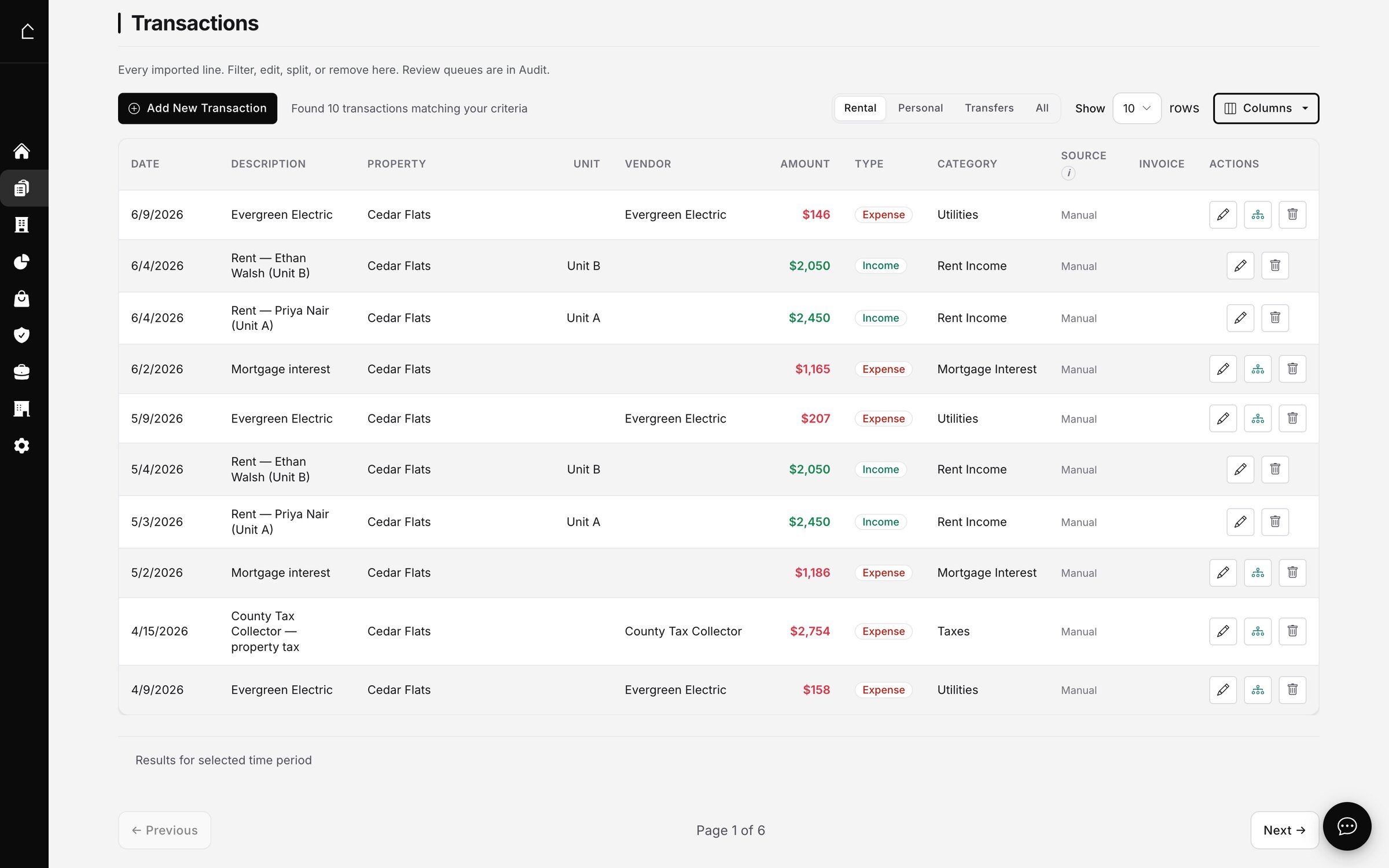
By hand, it is this split redone every time a shared bill arrives. In Oberlin24 I split a shared bill once, rental share to the property and the rest left as personal, and tick Always split this way. Every later bill from that company splits the same way as it comes in from the bank, and the first one, or one that looks off from the usual amount, waits for a quick confirm. Repairs to the tenant's unit stay whole on the property.
Prefer to keep your own? The workbook above is the whole method: one percentage, one line by line split, one depreciation sheet.
This is one piece of the monthly routine. I wrote up the whole thing, the four monthly moves and the year-end return, in how I do the bookkeeping for both rentals in about a minute a month.