Free tool and download
RUBS calculator: split a utility bill across units
A free RUBS calculator for a master-metered building. Split one utility bill across the units by occupants, square feet, bedrooms, equal shares, or a mix, with the arithmetic shown for every unit. Then book it the way Schedule E wants: the full bill on line 17, what the tenants pay back on line 3. No email, no signup.
| Unit | Occupied | Occupants | Sq ft | Bedrooms |
|---|---|---|---|---|
Educational calculator, not tax or legal advice. Some states and cities restrict or regulate RUBS, and the lease has to allow it. Check your local rules. Nothing you type here is stored.
- A split sheet for up to eight units, five methods, a common area share and vacant units the owner carries, with each unit's arithmetic written out
- A 12-month tracker of bills paid, billed to tenants, collected and still owed
- A Schedule E sheet with line 17 and line 3 side by side, and a sheet of common traps
What RUBS is
RUBS stands for ratio utility billing system. One meter serves the whole building, the owner pays the utility, and each tenant pays back a share worked out by a formula instead of a meter reading. Water, sewer and trash are the usual candidates, since they are the hardest to submeter. The formula is the part every RUBS calculator handles. The part they skip is the tax return, and that is where most landlords get it wrong.
A worked month
A fourplex with one master water and sewer meter. The bill is 840.00. The owner takes 10% off the top for irrigation and the laundry room, and splits the rest 50/50 by occupants and square feet. Unit 4 is vacant, counted as one occupant so its share does not move to the other tenants. The lease allows a 3.00 monthly admin fee.
| Step | Amount |
|---|---|
| Water and sewer bill for the month | 840.00 |
| Common area, 10% (the owner keeps it) | (84.00) |
| Amount to split across the units | 756.00 |
Seven billing occupants (2, 3, 1, and 1 for the vacant unit) and 3,600 square feet. Each unit's share, with the math shown:
- Unit 1: 50% x 2/7 occupants + 50% x 900/3,600 sq ft = 26.79% x 756.00 = 202.50202.50
- Unit 2: 50% x 3/7 occupants + 50% x 1,100/3,600 sq ft = 36.71% x 756.00 = 277.50277.50
- Unit 3: 50% x 1/7 occupants + 50% x 700/3,600 sq ft = 16.87% x 756.00 = 127.50127.50
- Unit 4: 50% x 1/7 occupants + 50% x 900/3,600 sq ft = 19.64% x 756.00 = 148.50, vacant, the owner keeps it148.50
| Who pays | Utility share | Admin fee | Total |
|---|---|---|---|
| Unit 1 | 202.50 | 3.00 | 205.50 |
| Unit 2 | 277.50 | 3.00 | 280.50 |
| Unit 3 | 127.50 | 3.00 | 130.50 |
| Billed to tenants | 607.50 | 9.00 | 616.50 |
| Owner: common area 84.00 plus vacant unit 4 at 148.50 | 232.50 |
The owner's 232.50 and the tenants' 607.50 add back to the 840.00 bill. The vacant unit's 148.50 is not billed to anyone. Split by occupants with unit 4 at zero, and the three tenants would have paid it for you.
How to book RUBS on Schedule E
Two lines, never one net figure. The full bill you paid is an expense on line 17, Utilities. What the tenants paid you back, admin fees included, is rental income on line 3, Rents received, next to the rent.
| The worked month | Schedule E | Amount |
|---|---|---|
| The full water and sewer bill | Line 17, Utilities | 840.00 |
| Utility reimbursements from units 1 to 3 | Line 3, Rents received | 607.50 |
| Admin fees from units 1 to 3 | Line 3, Rents received | 9.00 |
| Your net cost of the bill (840.00 minus 616.50) | Not a line | 223.50 |
The tempting shortcut is to deduct 223.50 and leave the reimbursements off. The net comes out the same, so the mistake survives. But line 17 no longer matches the utility's statements, line 3 no longer matches the deposits in your bank, and anyone reviewing the return has to reverse-engineer what happened. Keep both sides gross and the two reconcile on their own.
- Vacant units and common areas are part of the bill on line 17 and are never billed out, so they stay your cost.
- Admin fees a tenant pays you are rental income on line 3. A billing company's fee that you pay is a deductible expense, usually line 19, Other.
- Billed is not collected. On the cash basis most landlords use, line 3 gets what the tenants actually paid in the year. A December share paid in January is next year's income.
- A tenant who pays the utility directly on their own meter is not part of RUBS, and nothing about that utility goes on your Schedule E.
Which split method to use
- Occupants tracks water use best, since water follows people. It needs an occupant count you keep current.
- Square feet suits heating and cooling on a shared system, and it does not change when a roommate moves in.
- Bedrooms is a proxy for occupants when you do not track headcount. Count a studio as one.
- Equal works only when the units are close to identical.
- A mix of occupants and square feet is the common compromise for water and sewer, and it is what the worked month uses.
Whichever you pick, write it into the lease, use it every month, and show tenants the math. The workbook writes each unit's arithmetic in its own column for that reason.
Check the lease and local rules first
RUBS is not allowed everywhere on the same terms. Some states and cities restrict it or regulate it: what has to be disclosed in the lease, which methods and utilities are allowed, what fees can be charged. The lease has to allow the charge before you bill it. Check your state and local rules, or ask a local attorney, before you start. The calculator and the workbook do the arithmetic and the bookkeeping, not the legal part.
Where the numbers go next
The year's line 3 and line 17 totals drop into the Schedule E worksheet next to the rest of the property. To track each tenant's reimbursements alongside their rent, use the rent ledger template. Not sure where another expense belongs? The Schedule E expense categorizer answers it line by line, and the profit and loss template shows how the building did.
Frequently asked questions
How do you calculate RUBS?
Take the bill, subtract a common area share the owner keeps, and divide the rest by a ratio. By occupants, a unit with 3 of 7 billing occupants pays 3/7 of the amount to split. By square feet, a 1,100 square foot unit in a 3,600 square foot building pays 1,100/3,600. A mix weights the two, often 50/50. A vacant unit keeps its share and the owner pays it, so the other tenants are not billed for an empty unit.
Are utility reimbursements from tenants rental income?
Yes. What tenants pay you back for utilities is rental income on Schedule E line 3, Rents received, in the year you collect it. Admin or billing fees the tenants pay are line 3 too. The full bill you paid stays an expense on line 17, Utilities.
Can I just deduct the bill minus what the tenants paid back?
The net comes out the same, but report both sides. Line 17 should match the utility's statements and line 3 should match your deposits. A netted return matches neither, and it hides the reimbursement income anyone reviewing the return expects to see when the lease bills utilities back.
Who pays the vacant unit's share under RUBS?
The owner. Give the vacant unit its share of the split and keep it, usually by counting it as one occupant or by its square feet. Splitting only across occupied units moves the empty unit's cost onto the tenants. The owner's share, common area included, is part of the bill on line 17.
What is a fair common area percentage for RUBS?
There is no single standard. Owners commonly take 5 to 15 percent off the top for irrigation, hallway lighting, a laundry room or a pool on the same meter. Use a figure you can explain from what is on the meter, write it into the lease, and keep it the same month to month.
Is RUBS legal?
It depends on where the property is. Some states and cities restrict or regulate ratio utility billing, for example on disclosure, allowed methods, fees, or which utilities can be billed. The lease has to allow the charge. Check your state and local rules, or ask a local attorney, before you start billing.
How I do this in Oberlin24
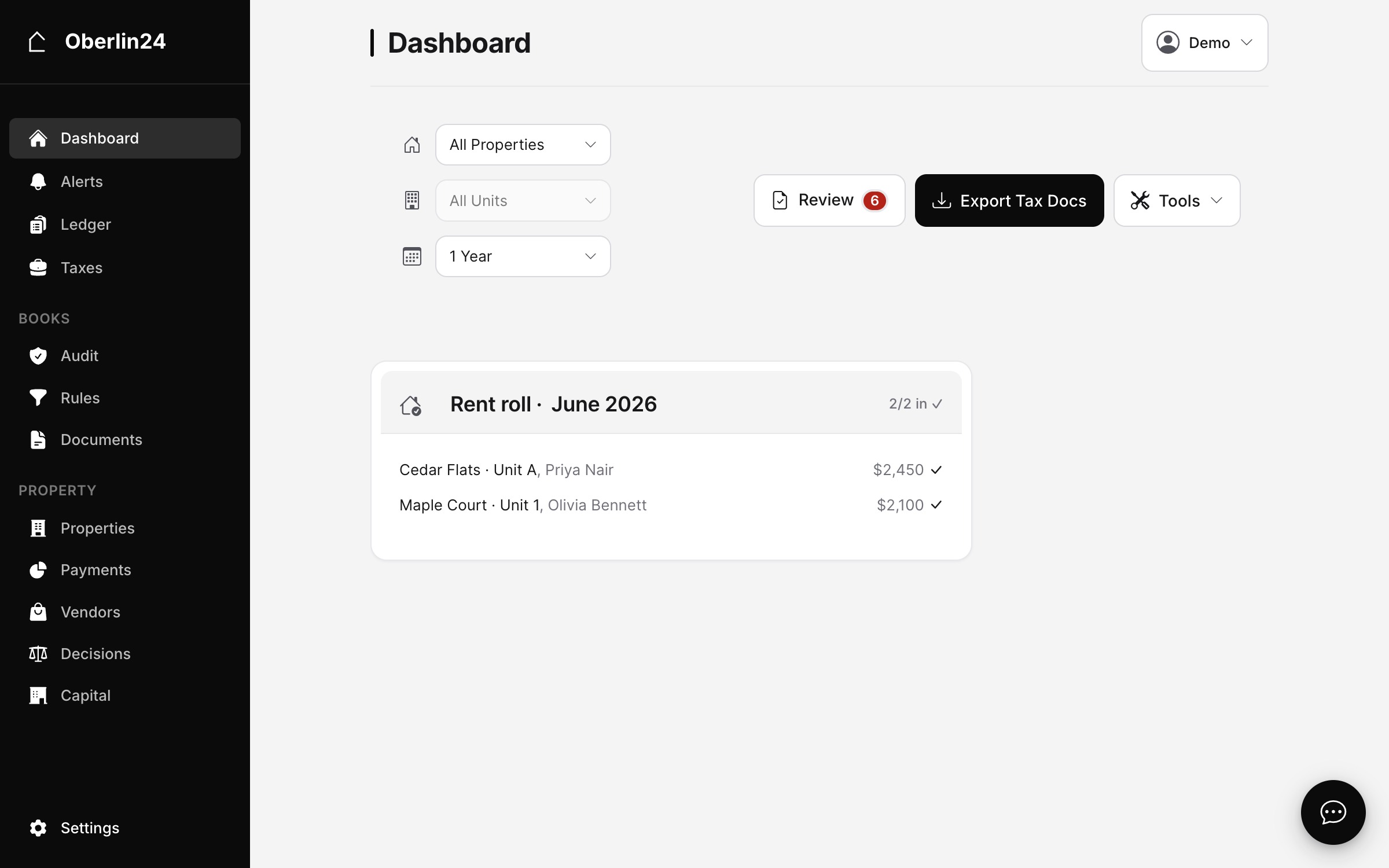
By hand, it is the split sheet above, once a month, and a tracker of who paid. In Oberlin24 the bill comes in from the bank feed and lands on Schedule E line 17 in full, on the right property. Where one bill covers more than one property, I set the split once and a recurring split rule divides each new bill by the percentages I chose. On the income side, each lease carries its expected monthly utility reimbursement, so the rent roll shows what is expected, still due, and received, and the reimbursements land on line 3 as rental income. The two are never netted.
Prefer to keep your own? The workbook above is the whole method: one split a month and one tracker row.
This is one piece of the monthly routine. I wrote up the whole thing, the four monthly moves and the year-end return, in how I do the bookkeeping for both rentals in about a minute a month.