Free download
Property management owner statement template
A free owner statement template in Excel for the owner on the receiving end. Your property manager deposits a net amount. Schedule E wants gross rent on line 3 and every deduction on its own line. This template turns one into the other, month by month, and checks that the numbers tie to the deposit. No email, no signup.
- One month in the manager's layout: beginning balance, rent per unit, fees, repairs, the owner distribution, and an ending balance that has to tie to the statement
- A 12-month gross-up sheet that turns each net deposit back into gross rent and expense lines, with a check that it equals the deposit
- A Schedule E mapping for the year, a 1099-MISC comparison, and a sheet of common traps (reserves, deposits, late fees, the fee base)
Educational template, not tax or accounting advice. Confirm your specific situation with your CPA.
Why the deposit is the wrong number for your taxes
A property manager collects the rent, takes the management fee, pays the plumber, holds back a reserve, and sends you what is left. That deposit is real money, but it is not your rent. Book it as rent and the return is wrong twice. Line 3 is understated, and the fee and the repair, both deductible, never make it onto the form. The net taxable figure can come out close, which is why the mistake survives for years. The 1099-MISC the manager sends in January reports the gross, though, and it will not match a line 3 built from deposits.
The free owner statement templates online are written for the manager, to send to you. This one is for the owner reading the statement: copy the lines in, check they tie, and carry each one to its Schedule E line.
A worked month that ties
Two units, an 8% management fee on rent collected, one repair, landscaping, and a reserve the manager raised from 500.00 to 750.00. The statement's own arithmetic has to hold: beginning balance plus income, minus expenses, minus the distribution, equals the ending balance.
| Owner statement, one month | Amount |
|---|---|
| Beginning balance held by the manager (the reserve) | 500.00 |
| Rent collected, unit 1 | 2,150.00 |
| Rent collected, unit 2 | 1,950.00 |
| Late fee collected, unit 2 | 75.00 |
| Total income collected | 4,175.00 |
| Management fee (8% of 4,100.00 rent collected) | (328.00) |
| Repairs: plumber, unit 1 kitchen drain | (285.00) |
| Landscaping | (120.00) |
| Total expenses | (733.00) |
| Owner distribution (the deposit to your bank) | (3,192.00) |
| Ending balance held by the manager | 750.00 |
| Difference from the printed ending balance | 0.00 |
Your bank shows one deposit of 3,192.00. The gross-up turns it back into what happened:
| Gross-up of the 3,192.00 deposit | Schedule E | Amount |
|---|---|---|
| Gross rent plus the late fee | Line 3, Rents received | 4,175.00 |
| Management fee | Line 11, Management fees | (328.00) |
| Plumber | Line 14, Repairs | (285.00) |
| Landscaping | Line 7, Cleaning and maintenance | (120.00) |
| Reserve raised from 500.00 to 750.00 | Not on Schedule E | (250.00) |
| Gross-up result | 3,192.00 | |
| Check: result minus the bank deposit | 0.00 |
Booked from the deposit, this month would show 3,192.00 of rent and no expenses. Booked from the statement, it shows 4,175.00 of rent and 733.00 of deductions. The 250.00 the manager held back is neither. It is still yours, sitting in the manager's account.
How the template works
The Owner statement sheet mirrors the layout most managers use. Type the figures from the statement into the white cells and the ending balance calculates. Type the ending balance the manager printed too, and the difference has to read 0.00. If it does not, a line has not been copied yet. A fee check multiplies the rate in your agreement by the rent collected and compares it with the fee charged.
The Gross-up sheet has one row per month. Enter the deposit that hit your bank and the lines from that month's statement. Each row calculates a gross-up result and a check column, which must read 0.00. The Schedule E sheet reads the twelve-month totals by reference and lays them on their lines: rents on line 3, commissions on line 8, management fees on line 11, repairs on line 14, and so on. It also compares line 3 with box 1 of the manager's 1099-MISC.
What stays off Schedule E
- The reserve. When the manager holds back money to fund or top up a reserve, nothing was spent. It is your money on the manager's books, a balance sheet item. The repair it eventually pays for is the expense, in the month the manager pays it.
- Security deposits. A new tenant's deposit can pass through the statement on its way to the manager's trust account. It is owed back, so it is a liability, never rent. Only the part you keep at move-out becomes income. The security deposit itemization form covers that.
- The distribution itself. The deposit is a transfer of money you already earned. In your books it moves cash from the manager's account to yours.
Common traps
- A fee on rent due, not rent collected. Most agreements charge a percent of rent collected. If a tenant paid late and the fee did not drop, the fee check shows it.
- Late fees. Late fees you receive are rent on line 3. If the manager keeps a share and shows it as a charge, that share is a management fee on line 11.
- Repair markups. A 10% maintenance coordination fee on top of the vendor invoice is a management fee. The vendor's charge is the repair.
- The 1099-MISC. Box 1 is the gross rent the manager collected for you, often thousands more than your deposits. That is expected. Line 3 should land close to it, and the template shows the gap.
- Timing. Rent collected in December and paid out in January belongs to December. Use the statements dated January through December, not the deposits.
Where the numbers go next
The year's totals drop straight into the Schedule E worksheet, next to the expenses you pay yourself, such as mortgage interest and insurance. Not sure where a charge belongs? The Schedule E expense categorizer answers it line by line. To check the deposits against the bank each month, use the bank reconciliation template, and the profit and loss template shows how the property did.
Frequently asked questions
What is a property management owner statement?
The monthly report your property manager sends with your payout. It starts with the balance the manager held for you, adds the rent and other income collected, subtracts the management fee, repairs and other charges paid, subtracts the distribution sent to your bank, and ends with the balance still held, usually a reserve. Those lines have to add up, and the template checks that they do.
Do I report the net deposit or the gross rent on Schedule E?
Gross rent. Line 3 gets the full rent the manager collected for you, and each deduction goes on its own line: the management fee on line 11, repairs on line 14, cleaning and landscaping on line 7, leasing commissions on line 8. Reporting the net deposit as rent understates income and drops deductions you are entitled to, and it will not match the 1099-MISC the manager files.
Is the reserve my property manager holds a deductible expense?
No. A reserve is your money held in the manager's account, so funding or topping it up is a balance sheet movement, not an expense. The deduction comes when the manager spends it on a repair, in the month the repair is paid. The template shows the reserve change separately and keeps it off Schedule E.
Why does my property manager's 1099-MISC not match my deposits?
Box 1 of the 1099-MISC reports the gross rent the manager collected for you, before fees, repairs and reserves. Your deposits are net of all of those, so the 1099 is almost always higher. Report the gross on line 3 and the deductions on their own lines. Line 3 should then land close to box 1, and the template shows any remaining gap.
Is the management fee deductible?
Yes. Fees a property manager charges for running a rental are deductible on Schedule E line 11, Management fees, in the year they are charged. A tenant placement or leasing fee is a commission, line 8. A markup or coordination fee on repairs is also a management fee. Check the fee against your agreement: most charge a percent of rent collected, not rent due.
Are security deposits on the owner statement income?
No. A security deposit is owed back to the tenant, so it is a liability whether the manager holds it in trust or passes it to you. It becomes income only when you keep part of it at move-out for damage or unpaid rent, and only the part you keep.
How I do this in Oberlin24
By hand, it is the gross-up sheet above, one row a month. In Oberlin24 I forward the manager's owner statement or upload the PDF. The app reads every line, checks that income minus expenses minus anything held back equals the deposit that hit the bank, and only then splits that one deposit into gross rent and each expense on its Schedule E line. The reserve stays off the profit and loss and deposits stay a liability. If the lines do not tie to the penny, it flags the statement instead of guessing. After a few months it recognizes the monthly deposit and proposes the same split for me to confirm.
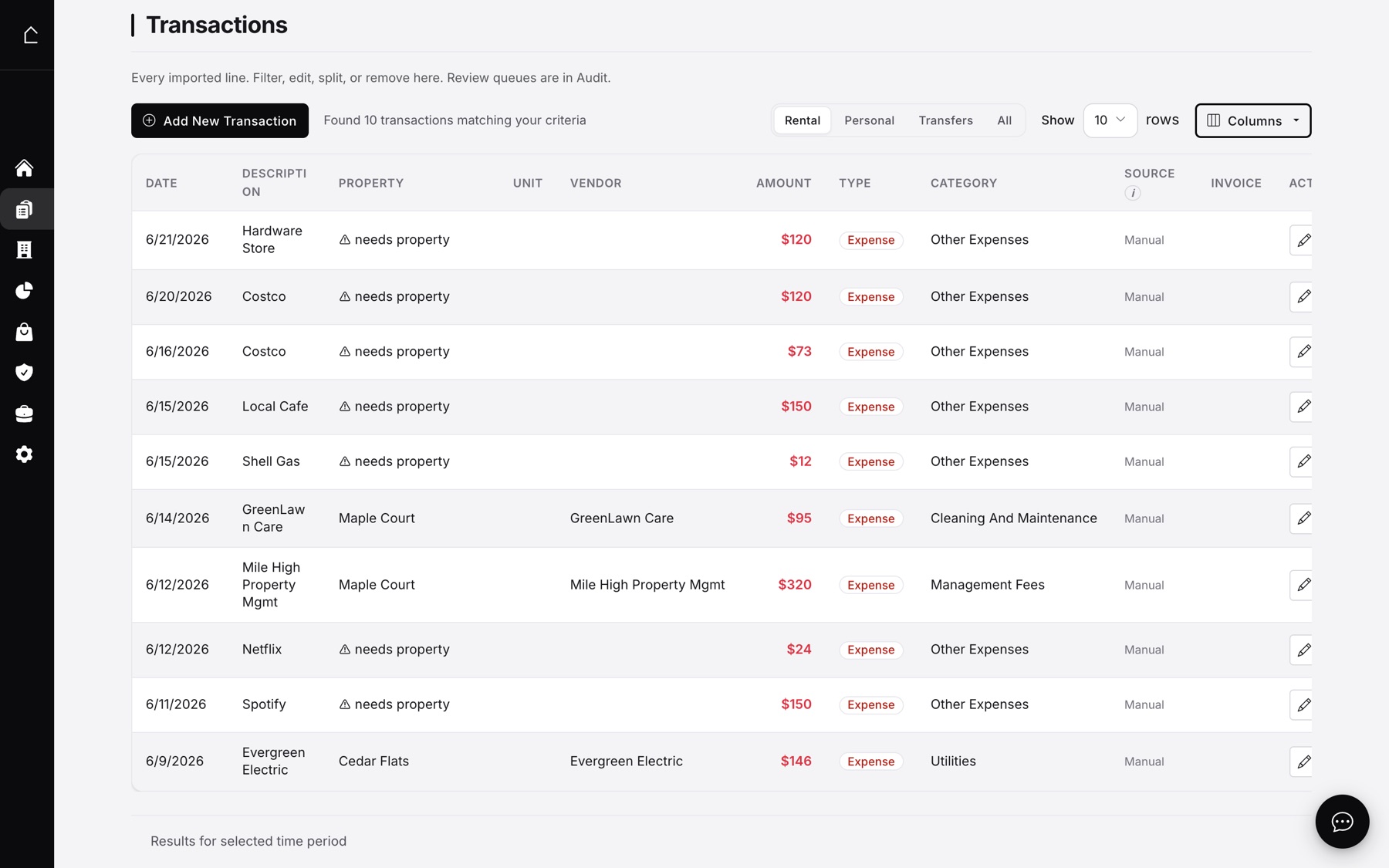
Prefer to keep your own? It is one row a month, copied from the statement when it arrives. The template above is the shape.
This is one piece of the monthly routine. I wrote up the whole thing, the four monthly moves and the year-end return, in how I do the bookkeeping for both rentals in about a minute a month.