Free download
Rental property bank reconciliation template
A free bank reconciliation template in Excel built for a rental account, not a generic small business. Both sides of the month, a difference that has to reach zero, and a line that takes tenant security deposits out of the balance so you can see what is actually yours. No email, no signup.
- Bank side and books side for one account and one month, with the difference and a Reconciled check calculating themselves
- Five item lists (deposits in transit, outstanding checks, money in and out the books missed, corrections), each feeding the reconciliation by reference
- A security deposit sheet and a rental traps sheet: the payouts, owner draws and mortgage splits that generic templates never mention
Educational template, not tax or accounting advice. Confirm your specific situation with your CPA.
What a bank reconciliation proves
Your books say the rental account holds one number. The bank statement says another. A reconciliation lists every reason the two differ, item by item, until the difference is zero. When it is, you know every dollar in the books really moved through the bank and every dollar through the bank is in the books. That is the check that makes a Schedule E trustworthy, because a missing charge or a rent payment booked twice shows up here months before it shows up on a return.
Do it monthly, as soon as the statement closes. One month takes a few minutes. Twelve months in March takes a weekend, and the answers are harder to find.
How the template works
Start on the Reconciliation sheet with two numbers: the ending balance on the statement and the ending balance in your books on the same date. Then list the items that explain the gap on the Items sheet. Items that the bank has not caught up with yet adjust the bank side. Items that your books have not caught up with yet adjust the books side. Every total flows back by reference, so nothing is typed twice.
| A worked month | Amount |
|---|---|
| Ending balance per bank statement | 12,480.55 |
| Add: rent payout in transit (paid the 31st, landed the 2nd) | 1,850.00 |
| Less: plumber's check and a deposit refund check, not cashed yet | (1,625.00) |
| Adjusted bank balance | 12,705.55 |
| Ending balance per your books | 13,019.30 |
| Add: interest the books did not have | 3.25 |
| Less: service fee and a returned-payment fee | (47.00) |
| Correction: a rent of 1,580.00 typed as 1,850.00 | (270.00) |
| Adjusted book balance | 12,705.55 |
| Difference | 0.00 |
The 270.00 correction is the kind of thing a reconciliation catches and nothing else does. A difference that divides evenly by 9 is almost always two digits swapped, and 270 is 30 times 9.
Why a rental account does not match
The generic templates stop at deposits in transit and bank fees. A landlord's account breaks in rental-shaped ways, and each one is on the Rental traps sheet with what to record.
- Payment app payouts. Avail, TurboTenant and similar apps release rent one to five business days after the tenant pays. Book the rent on the day it was paid. At month end the payout still in flight is a deposit in transit.
- Property manager owner draws. The deposit arrives net of the management fee and repairs. Record gross rent and each deduction separately from the owner statement; the entries net to the deposit.
- One mortgage autopay. One debit, three things: interest, principal and escrow. Only interest is an expense. The mortgage payment worksheet does the split.
- Escrow disbursements. Property tax and insurance paid from escrow never touch your bank. They are still deductions, recorded from the lender's statement, but they are not reconciling items.
- Returned rent. An NSF reversal lands after you booked the rent, usually with a fee. Reverse the rent and record the fee.
Security deposits: the balance is not all yours
A tenant's deposit raises the bank balance, but it is owed back. It is a liability, never rent. List each deposit on the Deposits held sheet and the Reconciliation sheet subtracts the total, so the last line reads what the account holds that is actually yours. Some states require deposits to sit in a separate account, and some require interest on them; if yours are separate, reconcile that account with its own copy and its adjusted balance should equal the deposits held. When a tenant moves out, the security deposit itemization form covers what you keep and why.
Where the reconciled numbers go next
A reconciled month is the input to everything else. The rent ledger shows which tenant paid what, the cash flow statement template shows where the month's money went, and the Schedule E worksheet is where the year lands. If the books are further gone than one month, start with the cleanup checklist. The full walk-through of the monthly routine is in how to reconcile rental property books without a bookkeeper.
Frequently asked questions
What is a bank reconciliation for a rental property?
It is a monthly check that the balance in your books for the rental account agrees with the bank statement. You start with both ending balances, list every item that explains the difference, and adjust each side until they match. When the difference is zero, every transaction in the books really went through the bank and nothing that went through the bank is missing from the books.
How often should a landlord reconcile the bank account?
Every month, as soon as the statement closes. A month takes a few minutes while the items are fresh. A year done at tax time means tracing twelve months of payouts, checks and fees from memory, and a missed charge or a double-booked rent payment is far harder to find eleven months later.
What are deposits in transit and outstanding checks?
Both are timing differences on the bank side. A deposit in transit is money already in your books that the bank has not posted yet, such as a rent payout from a payment app that lands two days into the next month. An outstanding check is a payment already in your books that has not cleared, such as a check to a contractor who has not cashed it. Both add or subtract on the bank side and clear on their own next month.
Why does my rental bank account not match my books?
For a landlord the usual causes are rental-shaped. Payment apps pay out days after the tenant pays. A property manager deposits the rent net of fees and repairs, so the deposit never equals the rent. One mortgage autopay is interest, principal and escrow at once. A returned rent payment reverses after you booked it. And a figure typed wrong, often two digits swapped, which leaves a difference that divides evenly by 9.
Are security deposits part of my bank balance?
They are in the balance, but they are not your money. A tenant's deposit is owed back, so it is a liability in your books, never rent. The template lists each deposit held and subtracts the total from the adjusted bank balance, so the last line shows what the account holds that is actually yours. Some states require deposits to sit in a separate account or earn interest, so check your state's rules.
Do I need a separate bank account for each rental property?
Not by federal tax law, but one account for the rentals and nothing personal in it makes the reconciliation far simpler. If several properties share one account, every transaction still needs a property tag in your books so the Schedule E for each property is right. The reconciliation itself runs per account, not per property.
How I do this in Oberlin24
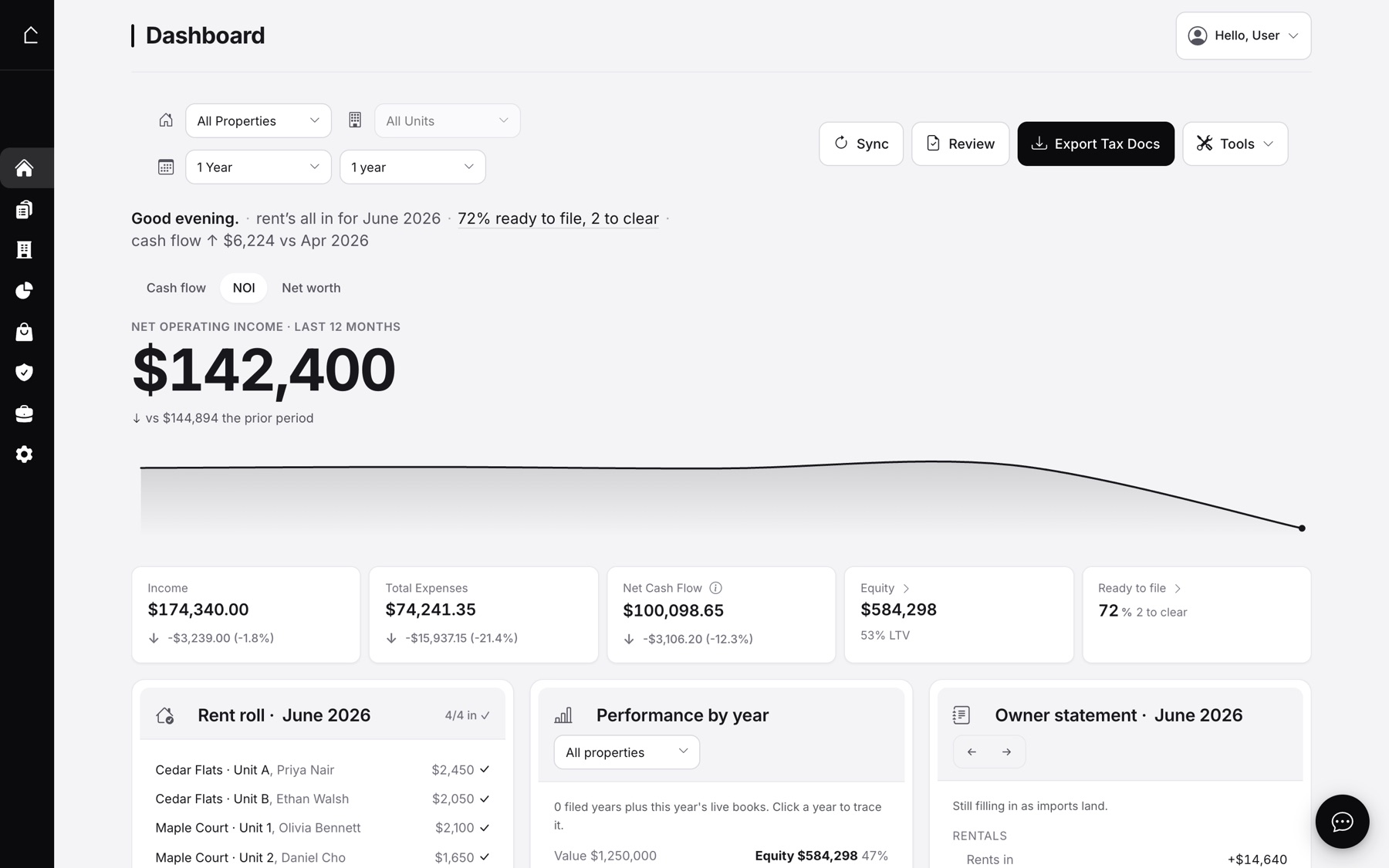
The app reconciles each connected account to the bank statement balance, to the penny. It splits the mortgage payment into interest, principal and escrow, and keeps tenant deposits as a liability rather than rent. When a month does not tie, it shows the difference and the transactions behind it. Here is the view the totals come from:
Prefer to keep your own? It is one sheet a month and the habit of doing it when the statement closes. The template above is the shape.
This is one piece of the monthly routine. I wrote up the whole thing, the four monthly moves and the year-end return, in how I do the bookkeeping for both rentals in about a minute a month.